Showing posts with label Frangipane. Show all posts

Tuesday, 21 July 2020

week 26 - Kitchen Diaries II - Nigel Slater


The English summer is now in full flow (as I write this while sitting under a blanket) and so we've been spending even more time arguing down at the allotment after work. Thankfully the soft fruits are hitting their peak, and so now the Ewing gets some peace to do 'proper' jobs while I'm distracted, like a sticky fingered-child, by picking said soft fruits. Of which approximately half make it into plastic takeaway containers to take home.

There are blackcurrants, whose leaves I recently plundered for my panna cotta; and gooseberries; and tiny golden raspberries alongside their bigger red cousins. But best of all are the jostaberries - a black currant and gooseberry hybrid - which have been rampantly growing since the Ewing got the allotment and planted them for me, knowing they were two of my favourite fruits. Thank you darling. (Oh, that's ok - TE).

Like many fruits, they also go perfectly with almonds. Originally I wanted to make a bakewell tart and replace the raspberries with jostaberries, but, leafing through the often overlooked second volume of Nigel Slater's Kitchen Diaries, I realised they would make a great addition to his frangipane and fruit-filled almond tart.

Additionally, as well as tasting great, jostaberries lack the vicious thorns of a gooseberry bush and are bigger than blackcurrants, making them very easy and much more satisfying to pick. Even someone with no patience, like me, can fill a tub (and their face) in no time at all.

I keep thinking the leftover berries would make a great flavoured vodka, or gin, but I never seem to have enough leftover to try it. Maybe this year....

Although I have given the frangipane recipe from Nige's book below, I have to confess I used leftover frangipane that the Ewing had frozen after making rhubarb danishes for me way back in March. Which we unearthed after doing one of our 'can't fit anything in the freezer' clear outs, which were supposed to have become less frequent during lock down but still happen with a predictable regularity. 

It turns out that frangipane freezes remarkably well, and I can also heartily recommend adding a slug of Grand Marnier and a dash of almond extract, if you have it.

My hot hands, combined with all the careful measuring that baking involves, make pastry a bit chore but I followed the recipe for the shortcrust faithfully (even though my tin was a little larger than the one specified) and it was glorious. Short, buttery and no hint of a soggy bottom. While I made it (honest), the Ewing was roped in to roll it out and line the tin. Thank you darling. 

Jostaberry and almond frangipane tart
Adapted from the Kitchen Diaries II

Pastry
200g flour 
100g butter
1 egg yolk 
Ice cold water 

Frangipane
100g butter 
125g caster sugar 
2 eggs
125g ground almonds 
60g plain flour
Good splash of Grand Marnier (optional)
1 tsp almond essence (optional)

Large handful of jostaberries or blackcurrants
small handful of untoasted slivered or flaked almonds

Icing sugar to dust (optional)

You will also need:
a round 22cm loose-bottomed tart tin at least 3.5cm deep
beans for baking blind

Put the flour and butter, cut into small pieces, into the bowl of a food processor. Add a pinch of salt and blitz to fine breadcrumbs. Add the egg yolk and enough water to bring the dough to a firm ball. The less you add the better, as too much will cause your pastry case to shrink in the oven.
Put the pastry in the fridge to rest for at least 30 mins and up to 24 hours.
Heat the oven to 200C. Put a baking sheet in the oven to warm. 
Pat the pastry into a flat round on a floured surface, then roll out large enough to line the tart tin. Lightly butter the tin, dust it with a small amount of flour, shake off any surplus then lower in the round of pastry. Push the dough right into the corner where the rim joins the base without stretching the pastry. Make certain there are no holes or tears. Trim the overhanging pastry.
Line the pastry case with kitchen foil or baking parchment and baking beans and slide on to the hot baking sheet. Bake for 20 minutes, then remove from the oven and carefully lift the beans out. Return the pastry case to the oven for 5 minutes or so, until the surface is dry to the touch. Remove from the oven and set aside. 
Turn the oven down to 160C, and return the baking sheet to the oven.

To make the filling, using a food mixer cream the butter and sugar together till pale and fluffy. Lower the speed, then mix in the eggs and then slowly fold in the ground almonds and flour. Spoon the almond filling into the cooked pastry case, smoothing it lightly with the back of the spoon.

Scatter the fruit on top of the almond filling and sprinkle almonds in the gaps. 
Slide the tart on to the hot baking sheet and bake for 40 minutes till the filling is well risen and golden brown. 
Remove the tart from the oven, dust with icing sugar if you'd like, and allow to cool slightly before serving. Preferably with double cream.


Tuesday, 17 March 2020

Week 7 -The Ultimate Baking Companion - Bourke Street Bakery

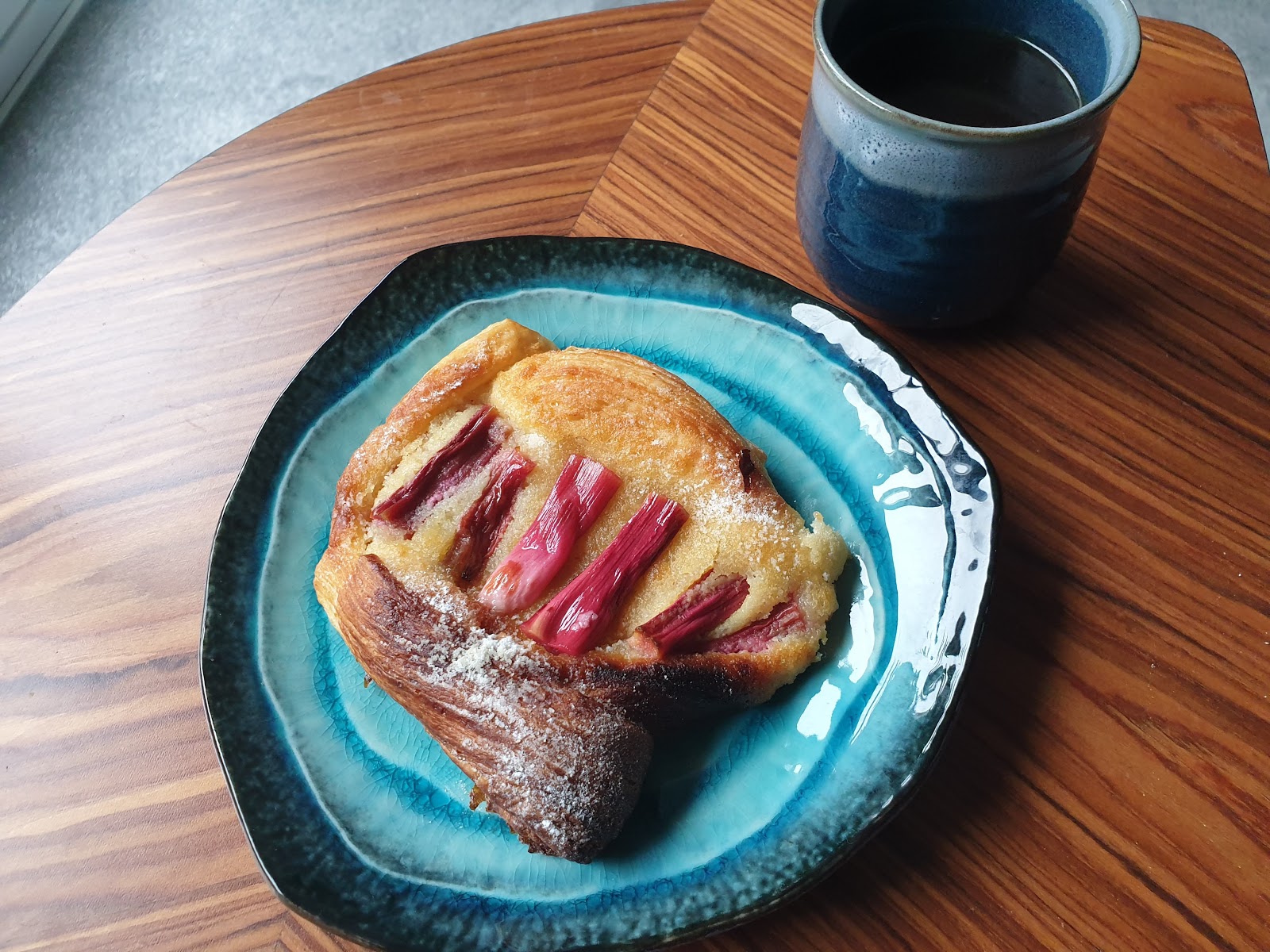
It started with a trip to the allotment a few weeks ago -  when the Ewing had upended a plastic barrel, and called me over to see what she knew was underneath; a small clump of rhubarb, glowing pink in the pale winter sun - and ended last weekend in our kitchen, with me asking for danish pastries that became a whole weekend's work for my wife. But worth it.

While I have no patience for anything in the kitchen, the Ewing is a careful and methodical baker and so I delegated the latest #cookbookchallenge to her (my challenge, my rules). The recipe was taken from the Bourke Street Bakery Cookbook, from the Sydney-based mini bakery chain of the same name that I first visited nearly a decade ago for their signature chocolate, lemon and creme brulee-topped tarts. It's a beautiful tome for a baker, of which I am certainly not. That being said, I did make their chicken and lime pickle pies. and I still think about them now.

Lamination is a laborious, if not strangely relaxing process (at least when I wasn't shoving my phone in the way to take pictures) that involved a whole block of Lescure dry butter and much folding and resting to get the signature layers of good viennoiserie. 

As if all the dairy products and roasted rhubarb wasn't enough, the Ewing also made bear claws filled with homemade frangipane with Cointreau that she also whipped up from a recipe in the book. And we finally used a jar of jam bought on our last trip to Paris. Which is lucky, as we're going back there next week and will certainly return laden down with more confitures.

The piece de resistance were a couple of off-cuts she rolled into traditional croissant shapes and that I stuffed with mortadella and sheep cheese studded with pistachios that we picked up in Sicily. A very tasty petit dejeuner.

Their recipe is for basic croissant dough, which can then be adapted into different shapes and filled or topped with whatever you would like. The pictures above show the croissant/pain au chocolat rolling instructions from the book. There are lots of danish designs, we Googled a few YouTube videos for inspiration. Ones that cut and 'twist' the dough show off the layers better than ones that are just folded over, although they are a little trickier to make. Bear claws are probably the easiest and probably my favourites. Probably because they remind me of the Ewing's toes.

Bourke Street Bakery croissant dough
(we halved the recipe below and made 8 rhubarb danishes, 4 bear claws and 2 croissants)

Ingredients:
For the ferment
100g strong white bread flour, chilled
50ml whole milk, chilled
1 tsp soft brown sugar
Pinch salt
5g fresh yeast
20g unsalted butter, softened

For the croissants
935g strong white flour, chilled
500ml whole milk
60g soft brown sugar
15g salt
35g fresh yeast, chilled
500g unsalted butter, chilled

Ideas for the fillings
Jam, cooked fruit, chopped nuts, dried fruit, chocolate, frangipane or creme patisserie

Make the Ferment (the ferment is a small amount of dough that needs to be made first and will help your croissant dough develop and rise)
Mix all ferment ingredients together in a bowl until it becomes a ball. Knead it for about 10 minutes until becomes elastic and smooth.
Put the ferment in a bowl covered with plastic and leave at room temperature for 2 hours to ferment. After, store the ferment in the fridge overnight (this can be kept for few days in the fridge).

Make the dough
Divide the ferment into 8-10 small pieces, mix it together with all other ingredients, except butter, in a mixing bowl until a dough ball is formed.
Transfer the dough ball to a bench and knead for 10 – 15 minutes (by hand) until the dough becomes smooth and elastic, and doesn’t tear when stretched gently.
Put the dough in a bowl covered with plastic bag or cling film and refrigerate for at least 2 hours or overnight.

Laminate the dough
Remove the butter from the fridge. gently pound the butter with a rolling pin between two sheets of baking paper into 20 cm flat square. If the butter becomes too soft, put it back in the fridge for 15 minutes before using.
Take the dough out of the fridge, using a lightly floured rolling pin, roll the dough out into a rectangle about 20 x 40 cm. Place the butter in the centre of the dough and fold the dough over the top. Seal the edges of the dough together to ensure the butter is completely enclosed in the dough.

Carefully roll the butter-filled dough into a rectangle, about 20 x 90 cm (approximately 3 times longer than the piece you started with). Fold the rectangle from one long end by one-third, then fold the other third over the top so your dough is now 20 x 30 cm – the same as you would fold a letter three ways to fit it into an envelope. Wrap the dough in cling film and refrigerate for 20 minutes.

Repeat this folding and resting process twice more, each time rotating the dough 90 degrees. After the final roll, place in the fridge for 20 minutes to rest, then remove and roll into a rectangle approx. 25 x 100 cm and 5 – 8 mm thick, trimming the edges if needed.

Cut the dough into squares/triangles/rectangles depending on what pastries you are making, then place the pastry shapes on lined baking sheets and chill for 10 minutes, covered with a damp tea towel.

Take the pieces of dough from the fridge and shape as required, adding fruit, chocolate, fruit, jam, frangipane or creme patisserie as you wish. Place the shaped pastries back on the lined baking sheets and cover again with damp tea towels.

Let the pastries stand at warm room temperature for 2 hours, or until they are almost doubled in size.

To bake the pastries
Preheat the oven to 240 C 
Whisk the egg wash ingredients together and brush the surface of pastries with the wash before baking. Put the croissants into the oven, then immediately reduce oven temperature to 190 C and bake for 20 – 25 minutes until deeply golden brown.