Showing posts with label Baking. Show all posts

Tuesday, 17 November 2020

week 42 - Lakeland Cookery

The last part of the Cumbrian Trilogy was, unlike many final instalments, a stone cold classic; the cheese scone. It's not a spoiler to reveal that I am currently sans a main oven at home (mainly as I have written about it almost constantly since the fan finally gave up the ghost), and so I made good use of the well-equipped kitchen we had in the Lakes. We even baked a bloody Christmas cake, which the Ewing has been feeding religiously with cherry brandy weekly since we got back home.

The recipe was given a Cumbrian twist by the fact it came from my latest purchase - Lakeland Cookery 'compiled from recipes supplied by readers of Cumbria'. While the original point of #cookbookchallenge was to utilise the many cookbooks I already possess, inevitably I have bought several (exact number unknown. Not that I'd disclose anyway, in case my wife is reading this...) since the challenge has begun. 

I saw this gem in a charity book shop in Kendal, so how could I refuse. And we picked up two St Michael cook books; the height of 80s dependability which adorned the bookshelves in both our mother's kitchens as we were growing up.

The scones received a further local boost by being filled with not one, not two, no not three, but four different types of Cumbrian cheese. The Holbrook (goat) and Fellstone (cow) came from Cartmel Cheeses (picked up after our visit to L'Enclume). While the Thornby Cumbrian Farmhouse (cow) was made down the road from where we were staying, and was left for us by our hosts. The final cheese was a gooey Eden Valley brie, that added some welcome ooze.

Cumbrian Cheese Scones - adapted from Lakeland Cookery

225g self-raising flour, plus extra for dusting
pinch of salt
1 tbsp finely chopped chives
1 tsp baking powder
55g chilled butter, cut into cubes (you can also grate if you put into the freezer for half an hour before you need it)
120g hard cheese, grated
30g brie or similar soft cheese, chopped into small chunks
90-100ml milk, plus 1 tbsp for glazing

Heat the oven to 180c with a baking tray inside. Sift the flour, salt and baking powder into a bowl.
Add the butter to the bowl and lightly rub in with your fingertips to make breadcrumbs. Add 100g of the hard cheese and all the soft cheese and gently stir in.
Make a well in the centre of the mixture and slowly pour in the milk it comes together into a dough.
Flour a surface and shape into a round. Place on baking parchment, cut into six wedges, glaze with milk and sprinkle with the remaining cheese. 
Place the baking parchment onto the hot oven tray and bake in the oven for 15-20 mins or until golden brown and cooked through.

I also made a bonus batch of Buttermere biscuits, and gave some to our hosts next door to say thank you for their hospitality. I was originally drawn to the recipe as they sounded very similar to a Shrewsbury biscuit - a crisp buttery biscuit flavoured with currants and lemon zest - which is one of may faves. When I Googled it afterwards I released the a Buttermere biscuit is a Shrewsbury biscuit. What's in a name? That which we call a cookie by any other name would smell as sweet.

Buttermere Biscuits - adapted Lakeland Cookery 

220g plain flour
110g butter
90g caster sugar, plus more to sprinkle on top
80g currants
½ tsp baking powder
1 large egg
Grated zest of one lemon

Rub the butter into the flour until you have fine breadcrumbs. Stir in the flour, currants, baking powder and zest.
Beat the egg in a bowl and add to the dry ingredients, cutting in with a knife. 
Bring the dough together with your hands. If it's dry, add a little milk or water.
Roll out to the thickness of a pound coin and cut into circles.
Brush the tops with milk and sprinkle a little sugar over the top. 
Place on lined baking sheets and bake for 15-20 minutes at 180c, or until a pale golden.

Saturday, 10 October 2020

week 35 - Salt, Fat, Acid, Heat - Samin Nosrat

One of the things I was most looking forward to about #cookbookchallenge was creating fancy confections with involved instructions, precise weighing and measuring and the kind of accuracy that normally I have no time for when rustling up dinner. In my mind I imagined embarking on Bake Off-style technical challenges and Food Network-style multi-tiered cakes that resemble anything that isn't actually a cake. But in reality I'm just not patient enough to be a master baker. 

I mean, in a plot twist I could announce that this pie was actually a cake that looked like a pie, but it was definitely a pie. Made from pastry weighed and measured and rolled out by my own hot little hands. And, although it's pretty rustic, I'm also pretty proud of it.

The recipe comes from Samin Nosrat's cult Salt, Fat, Acid, Heat, which also gave us the lockdown hit recipe of the summer; buttermilk brined chicken - I use use semi-skimmed milk with a tablespoon of white vinegar or lemon juice - which sounds like a faff but is actually dead easy if you remember to do it the night before (or even the same morning) and gives the chicken the most incredible bronzed carapace and tender flesh.

Anyway, back to my pie. As well as pastry you need a filling, and what is more classic than good old apple. Our apples were from the allotment, picked by the Ewing's fair hand. For a pie, I think you need an eater (so it doesn't disintegrate too much when baked). Something tart with a bit of crunch is perfect. Good old granny Smiths work, as do Braeburns or a Pink Lady.

I also added a handful of blackberries, as they are were also growing rampant at the allotment when we went to pick the apples. Although I think these are some sort of hybrid - maybe a loganberry? - as they are twice the size of the wild blackberries in our front garden.

And now to the pastry; my bĂȘte noire, Although, in all honesty, if I can make decent pastry it must be pretty simple. The key things seem to be get everything cold before you start; don't over-mix - you don't want gluten development as the pastry will be tough, a little vinegar also helps with this - don't add to much water to the dough; and allow the dough to rest before rolling it out. Seeing chunks of butter in the dough is also good, as the water in the butter creates stream when you put the pie in the oven, which expands into little air pockets and creates lovely crisp layers.

While the recipe included instructions to freeze the mixer bowl and the processor blades, as well as the flour and butter chunks, and then to freeze the whole pie again before baking, I skipped all that. You'd be pushed to fit get another pea in our freezer, and it all turned out fine. 

Classic Apple (and Blackberry) Pie with All Butter Pie Dough

300g plain flour
220g butter, cut into chunks - fridge cold or put in the freezer 30 minutes before you start
1 pinch salt
1 tsp cider vinegar
1 tbsp caster sugar
1/2 cup iced water

7 medium eating apples, peeled cored and sliced
handful blackberries, washed and dried
half a lemon
2 tbsp light brown sugar
1/4 tsp ground allspice
1/2 tsp ground cinnamon

2 tbsp double cream (or one egg, beaten)
1 tbsp demerara sugar

Add salt and sugar to the flour, add to the bowl of a food processor. Add butter, a few chunks at a time, and pulse until the butter is in pea-sized pieces.
Add the vinegar and then slowly add the water, pulsing until the mixture just comes together, you might not need it all.
Tip the dough onto a large piece of cling film and bring the sides of the cling film up, squeezing together gently, to shape the dough into ball. Cut the dough into half and flatten each half into a disc. Re-wrap each disc in cling film and place the dough in the fridge, preferably overnight but for at least an hour, to rest.
When you are ready to make the pie, preheat the oven, and a metal baking sheet at 220 C
Place the apples, berries, lemon juice, brown sugar, cinnamon and allspice in a bowl and stir carefully to mix.
Flour a surface and a rolling pin. Unwrap one disc of dough. Roll dough to about the thickness of a pound coin. Use this to line a pie tin – 20-22cm round and 4cm deep – leaving a slight overhang. 
Roll out the second disc to about the same thickness, ready to lay on top of the filling.
Tip the fruit mixture into the pie dish, leaving behind any liquid, which may make the base soggy. Brush a little water around the pastry rim and lay the pastry lid over the apples. Crimp edges or press down with a fork to seal.
Brush the pastry with the cream or beaten egg, and sprinkle over the sugar.
Place the pie on the baking sheet and cook for 15 minutes
Turn the oven down to 200c and cook for another -15/20 minutes
Turn the oven down again to 180c for another 30 - 40 mins (cover the top with foil if it is becoming too brown)
Allow to stand for half an hour before cutting (the most difficult part of the whole recipe) and serve warm or cold with lots of double cream.


Tuesday, 26 May 2020

Week 18 - The Two Davids - Outsider Tart

And just like that the Ewing was 40 (something). While a birthday stuck at home during a global pandemic may seem less than fun, it ended up feeling like a very special day. Starting with presents in bed, followed by flowers in the post, videos of our nieces and a phone call from my Mum, moving on to pink wine and lunch on the patio, films and a snooze on sofa and ending with homemade fried chicken and a personalised Zoom quiz with our friends.

As we weren't going further than the garden, we had plenty of time to plan the piece de resistance - a Bruce Bogtrotter-style Coke layers cake, from the Outsider Tart cookbook. A book that is already a firm favourite thanks to the incredible s'mores cake that contains a whole packet of digestives in the sponges, and is coated in blow-torched meringue. 

The Ewing is by far the biggest chocoholic I have ever met - one earlier date had me tearing around Greenwich, looking for a newsagent after she had a sugar crash and waited at the pub for me to return laden down with bars of Green and Blacks - and so I knew a recipe that contained over half a kilo of the stuff would always be a good choice. (Awww...that's true lurve - TE).

Plus it had marshmallows (we used chocolate coated, in case there wasn't enough chocolate already), nearly three quarters of a kilo of sugar, most of the EU butter mountain, and a can of Coke. Full fat of course. This is not a cake for those trying to exercise restraint.

In fact, it was the most joyful cake for the most joyful person. (You are so lovely, I love you very much - TE). A perfect fluffy sponge, sweet but with smoky caramel and a rich cocoa bitterness, coated in a tangy sour cream fudge frosting that perfectly gilded the lily. The ultimately celebration cake. And luckily she loved it. As did our neighbours (yes, after some gentle persuasion, the Ewing did share...). Happy birthday, my love.

Chocolate Coke Layer Cake
adapted from Outsider Tart

340g unsalted butter
350ml Coke (not diet)
65g marshmallows, chopped
85g plain chocolate, chopped
530g plain flour
115g cocoa powder
2 1/4 tsp baking powder
1 1/2 tsp bicarbonate of soda
3/4 of a teaspoon of salt
675g granulated sugar
80ml of flavourless oil
1 tbsp of vanilla extract
5 large eggs, at room temperature
300ml buttermilk, at room temperature

Chocolate sour cream fudge frosting
315g milk chocolate, chopped
200g plain chocolate, chopped
340g sour cream
1tsp vanilla extract

Preheat the oven to 180c Butter two 9 inch round cake tins, line the bottoms with baking paper, dust with flour and tap out any excess. 

Place the butter and Coke in a saucepan and heat over a medium heat until the butter melts. Add the marshmallows and chopped chocolate and stir until the chocolate and marshmallows have melted. Let the mixture cool for about 10 minutes.

In a medium bowl, whisk together the flour, cocoa powder, baking powder, bicarbonate of soda and salt, set aside.

Thoroughly combine the sugar, oil and vanilla in a kitchen mixer on medium speed or with an electric whisk. Reduce the speed to low and add the eggs one at a time, beating well after each addition. Add the cooled chocolate mixture and stir until evenly incorporated. 

Alternately add the flour and buttermilk in 3 or 4 stages, beginning and ending with the dry ingredients and mixing only until just combined. Divide the batter evenly among the prepared tins.

Bake for 50 minutes to an hour, or until a skewer inserted into the centre of each cake comes out clean. It is best to rotate the pans front to back, top to bottom about half the way through. If the cakes are browning too quickly, cover the top with foil.

Allow cakes to thoroughly cool on a cooling rack before slicing in half horizontally

To make frosting melt the chocolate in a heatproof bowl over a pan of simmering water.
Remove bowl from the heat and whisk in sour cream and vanilla.
Allow the mixture cool to room temperature, gently stirring occasionally.
When the frosting has thickened enough to spread, sandwich the layers together with the frosting, before covering the the top and sides. Work quickly, before the frosting sets, although you can gently reheat the frosting over simmering water if it thickens too much.


Tuesday, 19 May 2020

Week 17 Bill Granger - Sydney Food


This time last year we were in Australia. Drinking cold tinnies, camping in the bush and flinging another shrimp on the barbie. Since the government guidance to Stay Home, the furthest-flung we have managed to get is the patio. 

There are worst places to be, to be honest, especially since the weather has been almost uniformly glorious since lock down started. But in an attempt to bring some of the Antipodean vibe back to Buckinghamshire, I decided to make that Aussie classic (although a Kiwi may have something to say about that), the pavlova.

The recipe (sort of) comes from adored Australian restauranteur and food writer, Bill Granger; and is taken from his Sydney Food book - a hefty tome that was a kind gift from my sister. Just as kind was my Mum, who carted it back for me from Oz in her suitcase. 

One of my favourite memories from the trip we took to Australia for my 30th birthday, was going to Bill's in Surry Hills with my Sister and the Ewing and having his famed ricotta hotcakes with honeycomb butter. A recipe that I have also recreated at home, and is also in the book.

I never really thought I liked pavlova, as I never really liked meringue. Turns out that a real pav shouldn't be the classic crisp, feather-light meringue, which shatters on impact, but more a gooey marshmallow centre, held together by a thin, crisp crust.

This texture is achieved by a tsp of cornflour (or potato starch or arrowroot - Bill uses both) and a tsp of acid, either white vinegar or lemon juice. You then need to bake in a low oven to dry out the outside, without colouring it too much, and too keep the inside nice and squidgy.

This is something I learnt the hard way, after the first effort got over-baked (despite following the recipe cooking times) and then cracked after I needed to take it out the oven before it had cooled down, as I wanted to cook some chicken schnitzels and hadn't planned things as well as I thought I had....

The meringue for the second effort was slightly grainy, as I was too impatient when incorporating the sugar, which caused it to weep slightly when cooling (this time left in the oven overnight). But was also taller, and paler, and full of glorious vanilla-scented gooeyness. As it should be.

I topped mine with mango and blueberries, as that is what they had at the petrol station shop near our house (it is a Little Waitrose, so not quite as surprising as it may seem), but you could use any fruit. Strawberries and raspberries are great and passion fruit is my favourite. I also used some toasted coconut flakes that needed using up. It is recommended you serve as soon as you have put the topping on, but I think I prefer it best a day or two later, when it has become even more squidgy.

Pavlova
Adapted from a recipe by Bill Granger

For the meringue
4 egg whites
250g white caster sugar
1 tsp white wine vinegar
1 tsp cornflour (or potato starch or arrowroot)
1 tsp vanilla extract

for the topping
200ml double cream
200ml greek yogurt
fruit of your choice - I used mango, blueberries and toasted coconut

Heat oven to 110C
Using a pencil, mark out an 20 cm circumference on baking parchment. Turn the parchment upside down (you should still be able to see the outline of the circle) and place on a baking sheet.
Whisk 4 egg whites (use an electric whisk, unless you want a good work out) until they form stiff peaks.
Whisk in 250g caster sugar, 1 tbsp at a time, until the meringue looks glossy. 
Whisk in 1 tsp white wine vinegar, 1 tsp cornflour and 1 tsp vanilla extract.
Spread the meringue inside the circle, creating a small crater by making the sides a little higher than the middle. 
Bake for 1 hr, or until pale and set on the outside and still soft in the middle. Then turn off the heat and let the Pavlova cool completely inside the oven.
When the meringue is cool, whip the double cream to soft peaks and gently stir through the yogurt.
Spread gently over the top and decorate with the fruit of your choice.


Tuesday, 17 March 2020

Week 7 -The Ultimate Baking Companion - Bourke Street Bakery

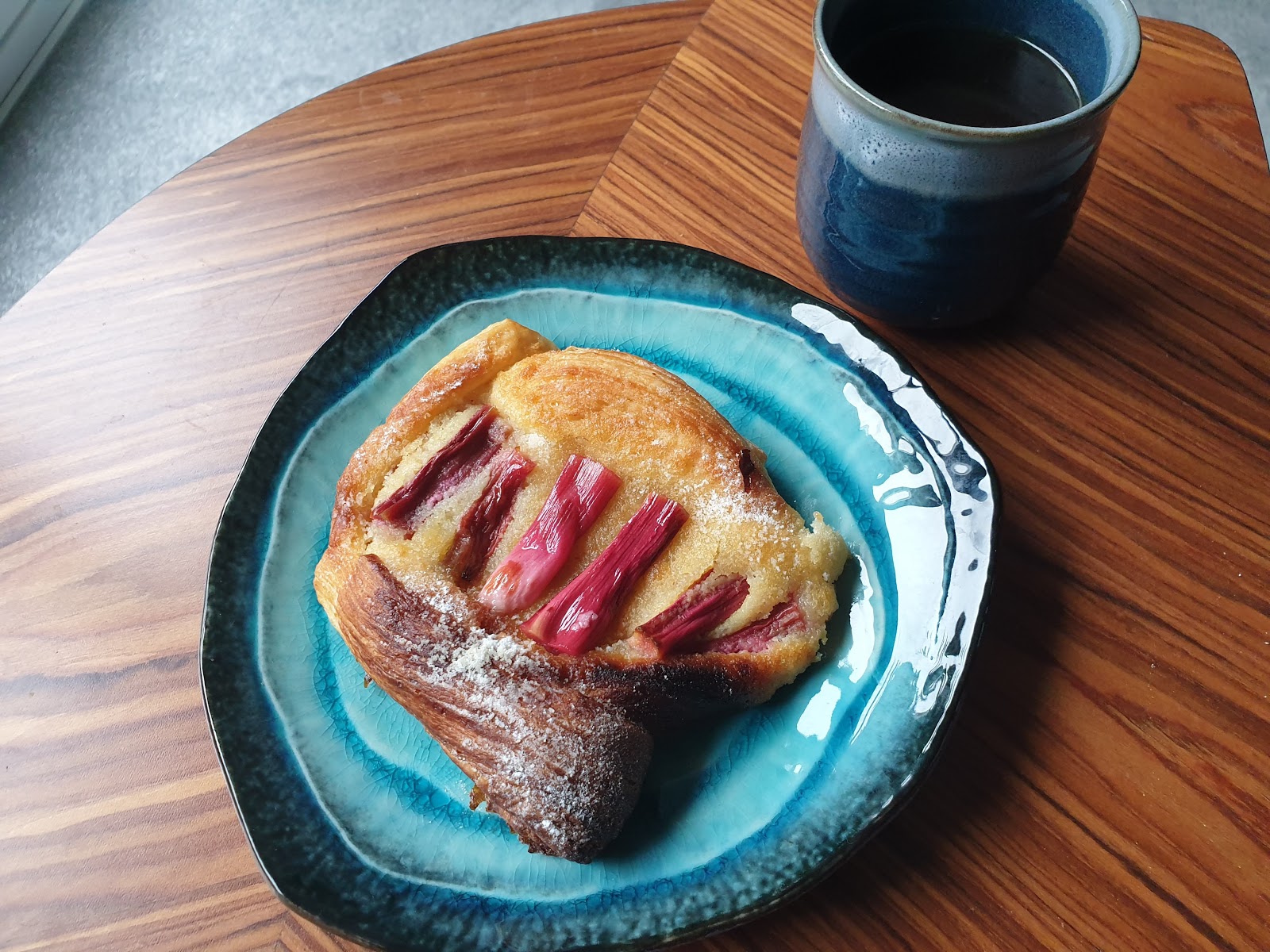
It started with a trip to the allotment a few weeks ago -  when the Ewing had upended a plastic barrel, and called me over to see what she knew was underneath; a small clump of rhubarb, glowing pink in the pale winter sun - and ended last weekend in our kitchen, with me asking for danish pastries that became a whole weekend's work for my wife. But worth it.

While I have no patience for anything in the kitchen, the Ewing is a careful and methodical baker and so I delegated the latest #cookbookchallenge to her (my challenge, my rules). The recipe was taken from the Bourke Street Bakery Cookbook, from the Sydney-based mini bakery chain of the same name that I first visited nearly a decade ago for their signature chocolate, lemon and creme brulee-topped tarts. It's a beautiful tome for a baker, of which I am certainly not. That being said, I did make their chicken and lime pickle pies. and I still think about them now.

Lamination is a laborious, if not strangely relaxing process (at least when I wasn't shoving my phone in the way to take pictures) that involved a whole block of Lescure dry butter and much folding and resting to get the signature layers of good viennoiserie. 

As if all the dairy products and roasted rhubarb wasn't enough, the Ewing also made bear claws filled with homemade frangipane with Cointreau that she also whipped up from a recipe in the book. And we finally used a jar of jam bought on our last trip to Paris. Which is lucky, as we're going back there next week and will certainly return laden down with more confitures.

The piece de resistance were a couple of off-cuts she rolled into traditional croissant shapes and that I stuffed with mortadella and sheep cheese studded with pistachios that we picked up in Sicily. A very tasty petit dejeuner.

Their recipe is for basic croissant dough, which can then be adapted into different shapes and filled or topped with whatever you would like. The pictures above show the croissant/pain au chocolat rolling instructions from the book. There are lots of danish designs, we Googled a few YouTube videos for inspiration. Ones that cut and 'twist' the dough show off the layers better than ones that are just folded over, although they are a little trickier to make. Bear claws are probably the easiest and probably my favourites. Probably because they remind me of the Ewing's toes.

Bourke Street Bakery croissant dough
(we halved the recipe below and made 8 rhubarb danishes, 4 bear claws and 2 croissants)

Ingredients:
For the ferment
100g strong white bread flour, chilled
50ml whole milk, chilled
1 tsp soft brown sugar
Pinch salt
5g fresh yeast
20g unsalted butter, softened

For the croissants
935g strong white flour, chilled
500ml whole milk
60g soft brown sugar
15g salt
35g fresh yeast, chilled
500g unsalted butter, chilled

Ideas for the fillings
Jam, cooked fruit, chopped nuts, dried fruit, chocolate, frangipane or creme patisserie

Make the Ferment (the ferment is a small amount of dough that needs to be made first and will help your croissant dough develop and rise)
Mix all ferment ingredients together in a bowl until it becomes a ball. Knead it for about 10 minutes until becomes elastic and smooth.
Put the ferment in a bowl covered with plastic and leave at room temperature for 2 hours to ferment. After, store the ferment in the fridge overnight (this can be kept for few days in the fridge).

Make the dough
Divide the ferment into 8-10 small pieces, mix it together with all other ingredients, except butter, in a mixing bowl until a dough ball is formed.
Transfer the dough ball to a bench and knead for 10 – 15 minutes (by hand) until the dough becomes smooth and elastic, and doesn’t tear when stretched gently.
Put the dough in a bowl covered with plastic bag or cling film and refrigerate for at least 2 hours or overnight.

Laminate the dough
Remove the butter from the fridge. gently pound the butter with a rolling pin between two sheets of baking paper into 20 cm flat square. If the butter becomes too soft, put it back in the fridge for 15 minutes before using.
Take the dough out of the fridge, using a lightly floured rolling pin, roll the dough out into a rectangle about 20 x 40 cm. Place the butter in the centre of the dough and fold the dough over the top. Seal the edges of the dough together to ensure the butter is completely enclosed in the dough.

Carefully roll the butter-filled dough into a rectangle, about 20 x 90 cm (approximately 3 times longer than the piece you started with). Fold the rectangle from one long end by one-third, then fold the other third over the top so your dough is now 20 x 30 cm – the same as you would fold a letter three ways to fit it into an envelope. Wrap the dough in cling film and refrigerate for 20 minutes.

Repeat this folding and resting process twice more, each time rotating the dough 90 degrees. After the final roll, place in the fridge for 20 minutes to rest, then remove and roll into a rectangle approx. 25 x 100 cm and 5 – 8 mm thick, trimming the edges if needed.

Cut the dough into squares/triangles/rectangles depending on what pastries you are making, then place the pastry shapes on lined baking sheets and chill for 10 minutes, covered with a damp tea towel.

Take the pieces of dough from the fridge and shape as required, adding fruit, chocolate, fruit, jam, frangipane or creme patisserie as you wish. Place the shaped pastries back on the lined baking sheets and cover again with damp tea towels.

Let the pastries stand at warm room temperature for 2 hours, or until they are almost doubled in size.

To bake the pastries
Preheat the oven to 240 C 
Whisk the egg wash ingredients together and brush the surface of pastries with the wash before baking. Put the croissants into the oven, then immediately reduce oven temperature to 190 C and bake for 20 – 25 minutes until deeply golden brown.


Wednesday, 5 August 2015

A Cake for the Boss and Another Celebration

Recently the Ewing and I got got hitched again. Well, more accurately, we had our civil partnership converted into a 'marriage'. Of course it would have been rude not to celebrate - despite originally choosing the 29th February as the 'big day', in the mistaken wisdom we would have less anniversaries to forget.

This second bite of the cherry, as it were, conveniently happened to commemorate exactly 2556 days since we first got together, which also lent itself nicely to the #sevenyearhitch hashtag. Any reason to dress up, cavort about town and drink pink fizz before lunch.

With all the merrymaking I've been distracted from blogging; although not enough to forget about the cake I made for the Ewing's lovely boss when she and her husband recently came for dinner. Yes, I really am a grown up now - although I did feel slightly like Reggie Perrin, minus the hippopotamus.

As well as a chance to impress it was an opportunity to utilise the good old Nutibullet - which, on a tangent, I have discovered is also perfect for making houmous and frozen strawberry daiquiris (although sadly not at the same time). Top hostess tip - add plenty of rum to the cocktails and no one really seems to care what the rest of the food tastes like.

This time I used it for  the far more prosiac task of grinding pistachios to make an adaption of Jose Pizarro's almond bizcocho, a dead easy Spanish-influenced loaf cake with none of your usual tiresome creaming, folding and whisking nonsense. Perfect for showing off on a special occasion, or just scoffing alongside a cuppa while nestled under a blanket on the sofa. If you don't have pistachios almonds will work just as well, although you're batter won't have that same ectoplasm hue before baking.

In keeping in with the anniversary theme, I used some flashy Italian olive oil I found buried at the back of my completely impractical kitchen cupboards (60 Minute Makeover, if you're listening...). The oil came from the olive groves on the estate where my Sister and brother-in-law got married exactly three years ago this week. (They celebrated with a bottle of vino from the estate vineyards and their first evening out without the Gingerbread.) A rather fitting use, although any light/medium bodied olive oil (or nut oil) would work equally well. 

To serve we went back to the 70's with a dish of classic caramel oranges; slices of citrus bathed in a brick red sugar syrup with plenty of Portuguese firewater and served icy cold. Yes it's a faff peeling and de-pithing, but make extra and you'll have something to liven up your breakfast yoghurt for the rest of the week.

Pistachio Bizcocho with Caramel Brandy Oranges 
(adapted from Jose Pizarro's Spanish Flavours)

For the caramel oranges
8 small, juicy oranges, 200g caster sugar, 100ml freshly squeezed orange juice, strained.

Method
For the caramel oranges, cut a slice off the top and bottom of each orange, then slice away all the skin, ensuring the white pith is completely removed. Cut each orange across the segments into slices, reserving all the juices. Put the sugar into a large pan with 120ml cold water. Leave over a low heat until the sugar has dissolved, then boil rapidly until the syrup has turned into a brick-red caramel. Don't lose your nerve!
Remove from the heat and plunge the base of the pan into cold water to stop it cooking any further. Stand back (as it will splutter) and add the orange juice. The caramel will form a lump in the bottom of the pan. Return to a low heat and stir until it dissolves again. Leave to cool very slightly then, while it is still liquid, pour over the sliced oranges and chill for at least 1 hour.

For the cake
200ml olive oil, 175g plain flour, 2tsp baking powder, pinch of salt, 100g ground pistachios (or almonds) 175g caster sugar, 3 large, free-range eggs, finely grated zest of an orange, 100ml freshly squeezed orange juice.  

Method
Preheat the oven to 170°C. Grease a 1kg loaf tin and line with greaseproof paper. 
Sift flour, baking powder and salt into a mixing bowl and stir in ground almonds and caster sugar. 
Make a well in the centre and add the beaten eggs, olive oil, orange zest and juice. Gradually mix the dry ingredients into the wet to make a smooth batter. 
Pour the mixture into the prepared tin and bake for about 1 hour, covering the surface loosely with a sheet of foil if it is browning too quickly. When it's ready a skewer, pushed into the centre of the cake, should come away clean.
Remove the cake from the tin and peel off the lining paper. Leave to cool on a wire rack. 
Serve with the caramel oranges and some lightly (not like mine, which went decidedly lumpy) whipped cream and a little ground cinnamon.