Showing posts with label Cook Books. Show all posts

Wednesday, 13 May 2020

Week 16 - British Food - Jane Grigson

This was the week that lock down began to bite. This happened in the most middle-class way possible after I discovered, late on a Saturday afternoon, that I didn't have all the ingredients I needed for the majestic pork pie I was planning. This became both a blessing and a curse.

A blessing because I decided we should walk to our great local butcher (about two and a half mile round trip, up a vertical hill), and a curse as we have gone there every weekend since. Completely derailing project #eatthefreezer and actually managing to contribute to the original problem. Ironically, they also sell extremely good pork pies. And scotch eggs and sausage rolls, if you're into that sort of thing.

I've made a hand raised pie before, a fancy number with chicken and apricots, but this time I went back to the old school with the pork pie from Jane Grigson's seminal English food. First published in 1974, and updated by Grigson in 1990, a year before her death, it's an anthology that celebrates and resurrects the reputation of English food, with recipes that range from rib-sticking puddings, pies and stews to summery soups, seafood and salads.

Alongside the classic mix of pork belly (Grigson actually uses spare rib, but obviously I didn't ready the recipe properly before setting off (really? that's unusual darling - TE)) and green streaky bacon, I added a couple of chicken thighs (to make up the weight) and chopped the meat and fat by hand for a chunkier texture. I also added a little allspice, cinnamon and nutmeg, as per Grigson's recipe. She calls for the addition of anchovy essence, and so I added a scant teaspoon of Gentleman's Relish, a gift from some foodie friends.

Jelly in a pork pie is a controversial thing, which I think most of us come to appreciate more as we get older. Grigson has a recipe for a traditional jelly, with split pigs trotters, but I decided I lacked the dedication to boil bones for hours to make something that will most likely be discarded on the edge of a plate and so plumped for stock, set with some leaves of gelatin. Originally I was going to use chicken, but I found some porcini stock cubes from a recent trip to Sicily, that I thought would add a heady, savoury note and turned out to be an inspired addition.

Of all the pastries, I think a hot water crust is by far the easiest. Melt the fat (lard, or a lard and butter mix) with water, then stir into flour and salt. The pastry can then be pushed up the sides of a loose bottomed cake tin, or fancy pie mould if you have one, leaving about a quarter to roll out for the lid, and that's about it. The lard adds a lovely crispness and a savoury edge and the pastry, with a little help from a beaten egg brushed on top, should bronze like a daytime TV presenter.

While the recipe may appear intimidatingly long, it's really very easy to follow, and the results are very impressive. Plus it tastes far better than a mass produced pie ever could. Although, I must confess I still have a fondness for the pink-paste stuffed pastry snacks, picked up from motorway service stations.


Hand raised pork pie
Adapted from Jane Grigson's English Food

For the filling
750g pork belly, shoulder or spare rib
250g streaky green bacon
250g skinless boneless chicken thighs (or just use 1kg of pork)
1 tsp salt
1 tsp black pepper
1 tsp Gentleman's Relish (or anchovy essence)
1/4 tsp ground allspice
1/4 tsp ground cinnamon
1/4 tsp grated nutmeg
Large sprig of thyme, finely chopped

for the pastry
500g flour
175g lard
200g water
large pinch of salt
1 beaten egg

for the stock
1 stock cube (porcini, ham or chicken)
2 leaves gelatin, soaked in cold water for 5 minutes
400ml boiling water

For the best texture chop the pork into small cubes, about 5mm in size. Or you could chop half, then whizz the other half briefly in the food processor.
Finely chop the bacon and chicken (if using)
Mix the thyme, salt, pepper and spices into the chopped meat.

Make the pastry
Put the lard and water into a saucepan and bring to the boil. 
Sift the flour and the salt into a large bowl. 
Pour the hot lard and water into the flour, mix well then leave until cool enough to handle. 
Don't allow to cool down too much, or you won't be able to shape it.

Pre-heat oven to 180C. Lightly grease and flour a 18 cm loose-bottomed cake tin. 
Take a quarter of the pastry and roll it into a lid that will fit the top of the cake tin. 
Place the the remaining pastry in the base of the tin, and then firmly push the dough up the sides with your fingers. If it slides down, leave it to cool a bit more. patch up any tholes otherwise the jelly will leak out. 
Spoon the filling into the tin and press it down. It should come almost to the top of the pastry.

Brush the edges of the pastry above the meat with beaten egg. Lower the lid into place and press tightly to seal with the edges. Poke a small hole in the lid (I used the handle of a wooden spoon) to let out the steam and put the tin on a baking sheet. 

Bake for 30 minutes, then lower the heat to 160C and bake for 60 minutes until the pastry is pale gold. Brush with the beaten egg and return to the oven for 30 minutes (the temperature should read 65c in the centre of the pie). Cover with foil if the top is browning too fast.

When the pie has cooled, add the boiling water to the stock cube and stir until dissolved.
Add the gelatin leaves and stir again.

Allow the mixture to cool a little and then, using a funnel, slowly pour the stock into the hole in the top of the pie. You may have to do this in stages to give the stock time to work it's way through the pie filling and settle .
Leave the pie to cool in the fridge, preferable overnight.

Serve with English mustard and a glass of bitter.


Monday, 6 April 2020

Week 10 How to Eat - Nigella Lawson

Couldn't get through #cookbookchallenge without another appearance from the blushing rhizomes that the Ewing has been forcing under a big plastic barrel on the allotment. The pale pink stems have been turning up in a compote on her yogurt and granola every morning but I also persuaded her to make Pig's Bum, the gloriously monikered steamed pudding that features in Nigella's seminal first tome, How to Eat.

How to Eat came out the year before I went to uni (just over two decades ago now...) and I remember reading my discounted and dog-eared copy while tucked up in bed (in the freezing downstairs bedroom, where I got chilblains and had to scrape the ice from the inside of the windows.) All character building stuff. Although I can't remember cooking much from it I remember being very taken by the idea a M&S steak and kidney pudding with a blob mustard and some steamed greens which turned up in her healthy eating chapter.

The pudding itself is based on a old school dinner favourite, named for the fact it resembles a porcine behind. Nigella's instruction sees some stewed rhubarb being mixed into the pudding batter. I adore a proper steamed pud, and, more excitingly, it also gave me the opportunity to use my new Mason and Cash Hacienda pudding basin. Got to get my kicks somehow....

While I feel it is almost sacrilege to say so, I wasn't sure there was going to be enough of the good stuff in the original recipe, so we also poached some batons for the top and reduced some of the syrupy juices down to soak into the sponge.

Pig's Bum - adapted from Nigella's How to Cook

125g self raising flour 
125g butter 
125g sugar 
300g rhubarb
2 eggs
4 scant tbsp milk 
1.5 tsp baking powder
2 tsp vanilla extract
Approx. 2 tbs sugar for simmering rhubarb, or to taste

Pre-heat the oven to 200c
Butter a pudding basin very well and boil a large pot of water large enough to comfortably accommodate the basin. I use a vegetable steamer.
Chop two thirds of the rhubarb into small chunks and the rest into longer batons (to be placed on top of the cooked pudding). Sprinkle with sugar and roast until tender (15 minutes covered in foil, then remove foil and then cook for another 5 minutes) .
Mash the coins of rhubarb and let it cool. Remove the batons of rhubarb and set aside. Pour the juices into a saucepan and reduce on the hob until thick and syrupy
Put all the other ingredients, minus milk into a food processor, or use a whisk, and mix until very smoothly combined.
Add the rhubarb puree and pulse or whisk quickly till combined with the batter. Do not overmix. Add the milk and pulse or whisk only till incorporated. Turn the batter into the basin. Cover securely with kitchen foil.
Put basin into boiling pot. The boiling water should come about half way up the basin..
Steam for approx 2 hours, topping up with boiling water if the water level drops too low. When a skewer comes out clean from the centre of the pudding, it's done.
Remove from pot and cool a little before turning out.
Top with the batons of rhubarb and pour over the syrup.
serving with lashings of custard.


Wednesday, 26 February 2020

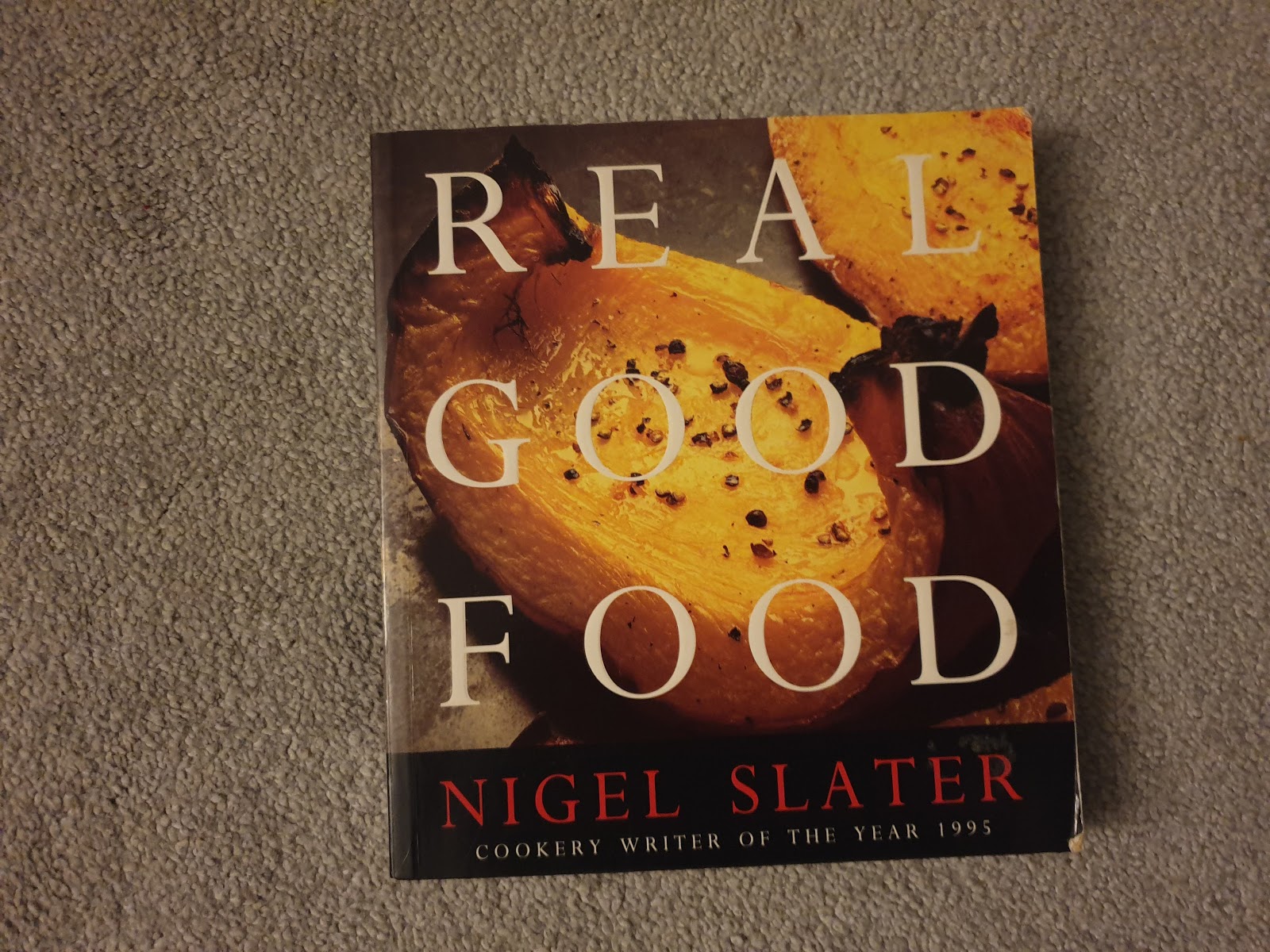
Week 5 - Real Good Food - Nigel Slater

February is not yet through and yet we're already back to lamb and already back to dear Nige. I didn't mean to return to Mr Slater so soon, but I have wanted to make this recipe since far before #cookbookchallenge began. In fact right back to my uni days, where I'd tuck myself in to bed and leaf through my rapidly growing collection of cookbooks, before dozing off while dreaming of steak and scallops (sadly the reality was more cheese toasties and tinned tuna).

While I always thought it was rather a summery-sounding recipe, after seeing lamb cutlets reduced on the Waitrose meat counter on the way home from work (already negating the benefits of any pay rise), I knew it was a sign and the time had come to finally make it. 

While it would be perfect thing to enjoy in more clement weather - taking delicate little frenched lamb cutlets, coating in breadcrumbs, fresh mint and Parmesan, and shallow frying until crisp outside and blushing pink within - it bought a little ray of sunshine into a gloomy February evening. Although we did enjoy with a glass of leftover port from Christmas, rather than a crisp glass of cold rose.

While it was slightly more effort than I would normally think of putting into my post-work scran, it was made far easier after I roped in the Ewing - who loves a good process to follow and is far more methodical that I am - to assist with the chopping and prepping and breadcrumbing. 

Lamb chops with Parmesan and mint
adapted from Nigel Slater's Real Fast Food

8 lamb cutlets or 4 lamb chops, fat trimmed
salt and freshly ground black pepper
2 eggs, lightly beaten
large handful of grated Parmesan cheese
50 g fine breadcrumbs
2 tbsp chopped fresh mint or parsley, mixed into the breadcrumbs
olive oil for frying
lemon wedges, to serve

Bash chops out carefully with a meat cleaver or rolling pin.
Press chops into the cheese, making sure it sticks well to both sides.
Dip the chops into the egg and then into the herby breadcrumbs.
Heat olive oil over medium-high heat in a large pan. Place 3 to 4 chops in the pan, you may have to do this in batches, reduce heat and cook until nicely browned, about 2/3 minutes per side.
If cooking in batches, place cooked chops an oven-proof dish and keep warm in a low oven. Repeat with remaining chops.

I'm pleased to report the effort was certainly worth it, as we both agreed it was one of the best dinners we had enjoyed for a while. And we certainly don't do badly on that front. In fact, for my next trick, I'm already thinking of trying something similar with pork steaks or veal and serving with spaghetti in tomato sauce.