Monday, 30 September 2013

West is Best: Lisbon Part 2

While the traditional cuisine of Portugal could never be described as fancy or refined, I love the simple combinations of uncomplicated ingredients and bold flavours (even if the surfeit of fried meat and fish may eventually cause even the most hardened lettuce-avoider crave a nice plate of greens after a week on Iberian shores).

With my own food memories from this beautiful country ranging from sardines straight off the boat, strewn with handfuls of crunchy sea salt and grilled over the barbecue; the waxy boiled potatoes, doused in butter; fuzzy-skinned almonds and figs picked and eaten straight off the tree; wobbly baked custards doused in bittersweet caramel; cinnamon flecked rice puddings; bottles of icy vinho verde that fizz on your tongue and snifters of sweet ruby port at the end of an evening, it's no wonder that I was keen to crack on with eating and drinking my way around Lisbon.

On family holidays to the Algarve when I was younger there was always at least one meal of crisp-skinned spit roasted rotisserie chicken to look forward to. Maybe it is nostalgia, but the chicken always seemed juicier and more ‘chicken-y’, with its faintly unnerving, corn-fed yellow hue. As a child just a little salt and lemon was all the seasoning I needed, but by the time I was approaching my teenage years I had been introduced to the delights of piri piri sauce, hot and fragrant with copious amounts of bird’s eye chillies and garlic.

Of course, a famous high street restaurant chain means we are never far from spicy chicken burgers and bottomless soft drinks now, but there is still something special about eating it here in Portugal, and of the many purveyors in Lisbon, Bonjardim is reputed to be the best.

Yes its busy, yes the service can be brusque and yes, you will probably be serenaded by an accordion player and asked if you want to buy a colourful hat or a beaded bracelet from the salesman that patrol up and down the Rua das Portas de Santa Antao, but at just 13 Euros for a whole bronze-skinned, sticky chicken to share between two, it’s all well worth it.

As well as the poultry, provided with communal pots of piri-piri and paint brushes for extra applications of sauce, we chose chips (Portugal’s fried potatoes must rank up there with the best) and a mixed salad. We also tried a (giant) dish of old-fashioned creamed spinach, which appeared faintly menacing with its nuclear green shade, but turned out to be the surprise hit of the night; the earthy, spiced vegetable toned down with liberal amounts of creamy béchamel. Rather odd, but very addictive.

Almost opposite Bonjardim is the Casa do Alentejo, home of the society of the Alentejo people (a Portuguese region ’beyond the Tagus’) in Lisbon. From the inauspicious frontage of the building you could be forgiven for walking past, but this place is well worth a visit, even if it’s just to look around the stunning Moorish interior.

As well as marvelling at the stunning courtyard and staircases we also enjoyed a meal in one of the beautiful azulejo- tiled rooms upstairs. The strip-lighting is harsh, the room is pretty noisy and food is simple, but this was one of the best meals of our trip.

We both chose the Alentejo pork with clams, one of Portugal’s most famous dishes. Rather confusingly this is supposed to have originated in the Algarve, but disputed origins aside we both quickly demolished the sticky, slow-cooked meat, briny bivalves and cubes of fried potato. As is common with many Portuguese restaurants, green vegetables were nowhere to be seen, but they did offer a large pudding menu to please the Ewing.

I chose the brilliantly titled toucinho do céu, or heaven’s lard, so named as it would have been originally made with pork fat (and, I presume, tasted heavenly). This was a light almond cake, soaked in sugar syrup and with a little citrus zing at the end that, thankfully, lived up to its name.

The Ewing was swayed by the Sercia cake, an Alentejan specialty made with eggs, milk, sugar and cinnamon. Normally served with prunes from Elvas (greengages preserved in a sugar syrup), this was given a twist by being accompanied by some fantastic, inky and rich prune ice cream, not often a word you would associate with the much maligned dried fruit.

A great evening was rounded off with complimentary shots of Alenjento mint liqueur, the perfect way to freshen your breath after dinner, while getting you even more hammered.

Possibly the highlight of the ourwhole trip was our dinner at Don Pedro in Cascais, a seaside town half and hour along the coast from Lisbon. This tiny little, picture postcard, restaurant, tucked down a cobbled alley behind the town hall is a spot well worth seeking out. As we were the first to arrive (booking is recommended) we got the pick of the tables in their courtyard, and quickly got stuck into bottle of freezing Vinho Verde in the shade of the cherry trees. 

While this tucked away setting might be rather romantic, it’s also rustic, friendly and, stupidly, cheap. We shared some gigantic, lemony piri piri prawns, with plenty of bread to dunk in the fluorescent spiced oil, to start, followed by cod fish ‘Don Pedro’; a platter laden with two huge salt cod fillets, smothered in peppers, onions and olives and served with the best boiled spuds I have possibly eaten, plus puds, port and wine for about 30 Euros a head.

Puddings were forgettable – crème caramel had turned to sweet scrambled eggs, and the base of the almond tart far too thick and solid– and there was a veritable slick olive oil keeping our cod main afloat - but with a glorious 2008 LBV port to round off our mean, and such a wonderful setting, it was easy enough to forgive.

Another little gem was fishing tackle shop-cum-trendy bar Sol y Pesca, down in the trendy Cais do Sodré. While this funky little hole in the wall originally sold rods and floats to fishermen, it now sells fish and wine to the beautiful people.

The concept is a simple one -  select your choice from colourful selection of tinned fish and seafood lining the walls, and they'll serve them to you with baskets of corn bread, fresh lemon and a cold beer or glass of vino.

We enjoyed a selection of tuna belly, octopus and smoked sardines, washed down with a bottle of red from the Douro, while we watched them paint the street outside an alarming shade of pink. No. I've got no idea either, but the fumes from the paint, plus lots of booze, made for an interesting walk back up the hill home later.

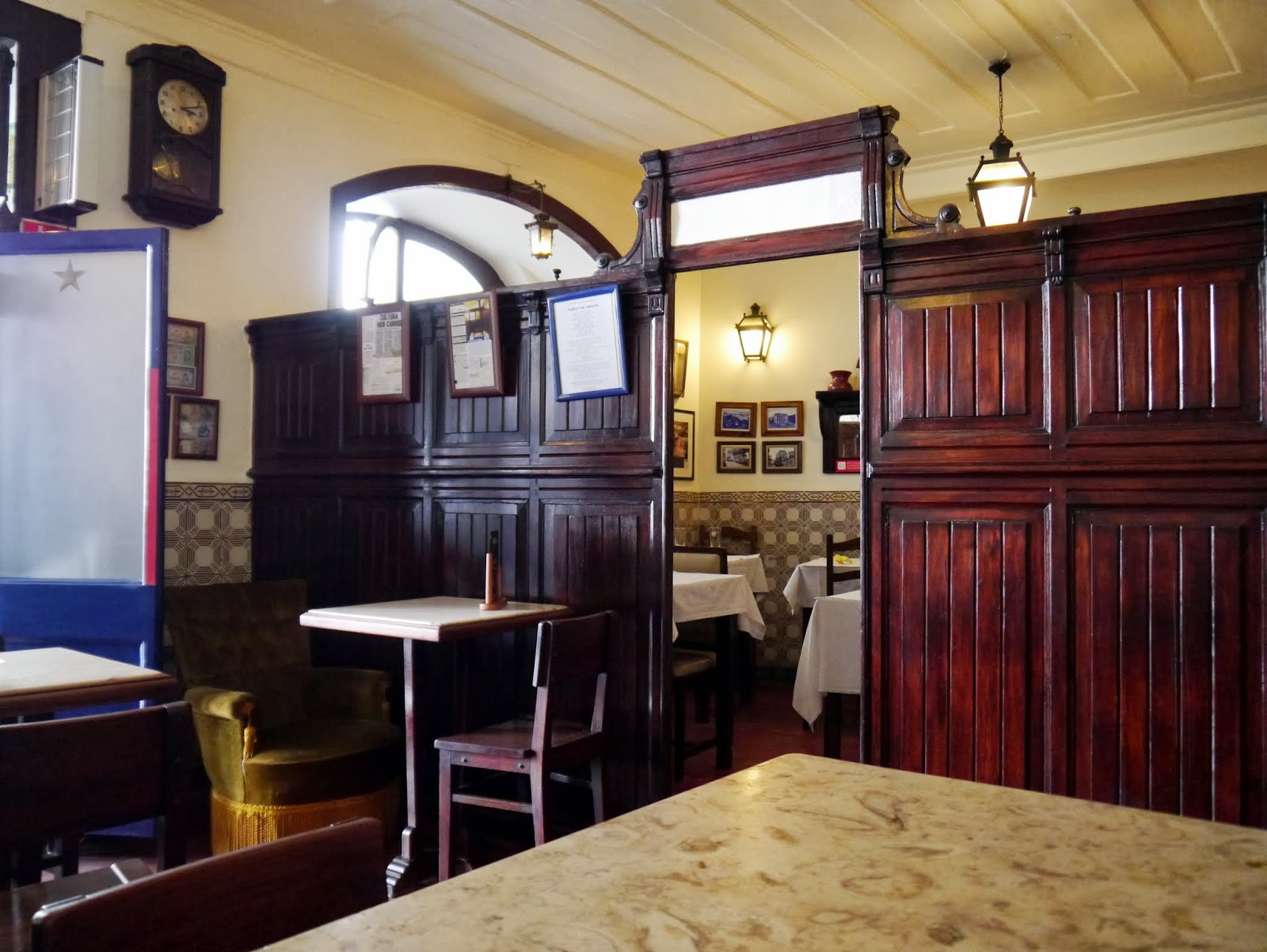
Our penultimate day saw us make a hot and sweaty trudge from the Castelo down through the narrow streets of the Alfama, ending up at the Estrela de Se, by the cathedral, for a late lunch. A lovely dark and cool spot, with its discreet 19 Century wooden booths decorated with beautiful azulejo tiles, offering a small menu of simple lunch dishes and tapas-type bar snacks.

I chose the alheira, a type of Portuguese sausage, made (usually) chicken and bread. Although its name derives from the Portuguese word for garlic (alho) it was originally invented by the Jews of Portugal, who attempted to deceive the Portuguese Inquisition by hanging the, porkless, sausages in their smokehouses to throw them off the scent. 

While I loved the story behind this dish, I found the filling of the sausage itself a bit too 'paste' like and lacking in seasoning. Great chips, though, and the Ewing enjoyed her plate of cured meats and cheeses, including a very nice goat that went perfectly with our bottle of vinho verde. 

While we hadn't planned any fancy meals during our trip, walking past the window of Solar dos Presuntos (the House of Ham), - piled high with lobsters, clams, and of course the obligatory legs of glistening ham - necessitated a change of plan. And with reservations made, and wearing our best bib and tucker, I was very much looking forward to our visit. 

Things got off to a good start with plates of green olives, crusty bread with garlic butter, sheep's cheese and salami. Of course, the piece de resistance was the cured mountain ham the restaurant takes its name from- shaved into wafer thin pieces that dissipated into a cloud of smoked porkiness as I draped them over my tongue.

There was a slightly awkward moment when the Ewing nearly managed to break the i-Pad as she was scrolling through the wine list, but thankfully it unfroze in time for us to pick a nice bottle of red from the Dao. If you aren't sure what to drink the handy apps allow you to match wine with your food, search by region and price or choose a recommended bottle (although one of their top choices did seem to be a Matteus rose, Hmmm).

My cabrito al forno (roasted kid) was quite brilliant. The meat had been marinaded in a spice paste before roasting and was a perfect mix of crisp and fatty, there was even some baby goat ribs to nibble on. The only downer was the double dose of carbs; sides of both rice and boiled spuds, as nice as they were, proved rather too much, with only a solitary wheel of orange and a couple of strips of pepper contributing toward my five a day.

The Ewing also enjoyed her feijoada de marisco, a seafood stew with prawns, clams and white beans in a tomato sauce, served in a hefty portion alongside heaps of fluffy white rice but sans any greenery (aside from a sprinkle of parsley). 

Needless to say, with second helpings of our mains being offered to both of us, puddings were out of the question - although we were given strong coffee and two red carnations to finish the meal. Resolutely old school, but still rather sweet.

Lunch on our trip up into the mountains was at Restaurante Regional de Sintra, a reassuringly old-fashioned and dependable sort of place, tucked in a side road to the ornate Town Hall, a few hundred metres from Sintra’s train station. The menu is a roll call of solid classics and I felt compelled to order the Beefsteak Portuguese Style, which came wrapped in cured mountain ham, doused in a glossy gravy and topped with crisp discs of fried potato.

The Rough Guide had given a mention to the seafood crepes, which the Ewing ordered and tucked into with as much gusto as is sensible with something that was served from the kitchen at a temperature hotter than the sun’s surface. As well as large Atlantic prawns decorating the top and clams nestling in the tomato-tinged béchamel there ware, rather bizarrely, strands of retro crab stick strewn throughout, which only made her like it more.

Although the Ewing’s not the most gracious sharer, we had agreed to swap our dishes half way through lunch, for a proper take on surf and turf. As the house wine was 4 Euros for a half bottle, we could also swap between red and white when we swapped plates. Now that’s democracy in action.

Forget about big Macs and Whoppers while in Lisbon. The favourite Portuguese fast food is the bifana (pork) or prego (beef) roll, served on crispy bread, with lashings of yellow mustard. The best bifanas are reported to come out of the kitchens of Bire Gare, next to Rossio train station. They offer a full menu of steaks, rice and seafood, but most people come here to stand at the counter, drink cold Sagres and eat hot bifanas.

Our sandwiches, one of each, were as heavenly as promised. The prego featured a steak of tender and well seared meat, while the bifana was magnificent; juicy and sloppy and stuffed with strips of pork. Those who fear for their arteries should probably avoid looking at the frying pan full of dripping in which meat is cooked that can be seen through the front window. Rather sobering (even after all the lager we had consumed during the evening), but utterly delicious.

Predictably, old Ronald has decided to cash in on the slice of the action, electric billboards advertising the ‘McBifana’ were all over the city on our visit. While I can’t vouch for their (in) edibility, I can vouch for the bifanas at Bire Gare, who also make fabulous suckling pig croquettes - like a crispy pancake full of sweet, shredded pork - and crispy salt cod fritters, too.

With the fresh fish and seafood, local wine, and delicious cakes and ice creams consumed during our stay (and the very reasonable prices, to boot) my opinion of Portuguese food has only been cemented. And for those who can't face another sardine, jump on tram 15 up to the Alfama, grab a cold Sagres, and enjoy the wonder of a view like this.

Monday, 23 September 2013

Green Tomato and Cinnamon Streusel Cake

Arriving home, sans jumper, to rainy Heathrow from balmy Lisbon a couple of weeks ago, I had to concede defeat that autumn was well and truly on the way. While dark mornings and chilly toes seem sad after such a cracking summer, there is also the excitement of log fires, red wine, Sunday roasts and steamed sponge puddings to look forward to.

The end of summer also brings a glut of unripe tomatoes, those steadfast fruits that have stubbornly remained green. While my allotment owning colleague, Oliver, assures me storing them with ripe bananas will soon turn them red, I love the crunchy, freshness of pickled green tomatoes or a good dollop of green tomato chutney on a ham sandwich. And so it was with some delight that I found a table laden with them at a recent trip to the farmer's market.

Of course, man can't live on pickles alone - although there was a point as a student, circa 1999, where I did try - so with my cache safely home, I began to think of other ideas to use them all up. Salsas, sauces, curried, fried and stuffed, the humble tomato is a pretty flexible friend in the kitchen. However, it was the idea of baking a cake with them that really piqued my interest.

While tomatoes in a cake may seem pretty grim to some, when you consider that carrots, beetroot and courgette can all make delicious baked goods, adding both texture and moisture to the batter, it doesn't seem like quite such a crazy idea. If you actually try an unripe tomato, they surprisingly taste of very little; not developing there sweet, savoury flavour that we are so familiar with until they finish ripening. Making them a perfect building block for any other flavourings you want to mix in with them.

I decided to use mine in a traditional US style coffee cake (one to drink with a cup, rather than containing the beans themselves), topped with a rubbly, cinnamon and ginger infused streusel. Internet wisdom also seems to suggest that under ripe tomatoes can happily replace both rhubarb and carrots in most cake and muffin recipes, and can even be used instead of apples in a pie. While that may be a step too far, even for me, my efforts with this cake proved surprisingly successful.

While the finished streusel cake garnered a resounding two thumbs up, being moist, spicy and crumbly, the neutral flavour of the tomatoes meant I would probably try throwing in a handful of raisins or some chopped walnuts, or both, to the batter the next time, for added intrest; all the better if the raisins have been soaked in some dark rum beforehand. If you like icing on your cake, then skip the streusel step in the recipe below and top the finished, and cooled, cake thickly with cream cheese icing.

Green Tomato Cake with Cinnamon Streusel Topping
(Adapted from Earth Outlet)

120g white flour
120g wholemeal flour
200g light brown sugar
3 tsp cinnamon
1 tsp ground ginger
1/4 cup vegetable oil
2 eggs, beaten
200g finely chopped green tomatoes
50g raisins or chopped walnuts (optional)
½ tsp baking soda
1 tsp baking powder
½ tsp salt

Set oven to 180c and grease a 8 inch square baking tin.
Put both the flours, the sugar, 1 tsp of cinnamon and the ginger in a mixing bowl, add the vegetable oil and stir with a fork until you have a mixture that resembles rough breadcrumbs.
Take half a tea cup of mixture from the bowl and mix in the rest of the cinnamon. Keep to the side, as this will make the streusel topping.
Add the tomatoes, eggs, raisins or nuts (if using) baking soda, baking powder and salt to the rest of the mixture and mix thoroughly.
Add mixture to tin and scatter the streusel topping evenly over.
Bake for 25 minutes, or until a skewer inserted into the middle of the cake comes out clean.
Leave for 20 minutes in tin before turning out onto a baking rack to cool. Cut into squares to serve.
The cake is very moist and is best eaten as soon as possible, but will keep for 3-4 days in an airtight tin.


Sunday, 15 September 2013

Caiprinhas and Custard Tarts: Lisbon Part 1

While the pastries of Portugal may not be as famous, or showy, as those of their European cousins, they have a proud and varied heritage of sweetmeats to rival any Parisian cake shop. Indeed the Portuguese princess, Catharine of Braganza is even credited with introducing ‘high tea’- a cuppa and cakes in the late afternoon - to the English.

Originally the love of deserts came from the Moorish occupation and the planting of sugarcane in Maderia in the 15 century. Later the convents and monasteries of Portugal produced large quantities of eggs, whose egg-whites were in demand for starching of their habits and robes, as well as fining local wines to remove impurities. This left large quantities of surplus egg yolks, resulting in the monks and nuns inventing copious sweet desert recipes to use them up.

One of the charms of Portuguese pastries is their wonderful names, mostly linked to the convents where many of them were created. You can find, amongst others, barrigas de freira (nun’s bellies), pao de Deu (bread of God - sweet buns, topped with coconut, that were served warm at our hotel breakfast every morning) papa de anjo (angel's chin) and toucinho do céu (heaven’s lard). With names like that, how could you resist?

No one could seriously contemplate a trip to Lisbon without hopping on Tram 15 along the seafront to Belem to visit the Jerónimos Monastery and eat a famed custard tart.

It is believed that these pastéis de nata were originally created here by Catholic monks in the monastery, before the Liberal Revolution of 1820 saw their production moving to the Casa Pastéis de Belém down the road. And their popularity over the last 200 odd years doesn't seem to have waned. You can almost guarantee, despite the deceptively large interior with its warren of tiled rooms inside, that there will be hordes queuing hungrily on the pavement. The day of our visit was no different, although you can slip the queue for counter service and find your own table indoors if you prefer to sit in to eat.

The tarts were - appropriately, given their origins - divine. Friable pastry cases gently cradling a warm creamy filling just on the point of beginning to curdle (traditionally served like this for the texture) sprinkled thickly with cinnamon and washed down with thick cups of bica.

While there are reports that the tarts served down the road may be even better, it's worth visiting at least once for cakes and coffee during your stay in the White City .

While Belem has its custard tarts, Sintra has its cheesecakes, and again, we couldn't leave without buying a couple of prettily wrapped tubes while on our trip up into the mountains; these are not the quivering slices of confection from across the Pond that most of us are more familiar with, but more little sugar and egg yolk-enriched tarts with the addition of fresh cheese curds. They most reminded me of our own treacle tart, with their dense, tooth-achingly sweet filling. Good in small doses.

After taking a quiet stroll through the steep streets of Alto Barrio on a Sunday morning, we felt well deserving of a little snack. While many bars and restaurants still remain closed on Sunday, a display of cakes and cool drinks, including some honey buns marked as the speciality of the house, lured us through the door of Pastelasria Camoes on Rua do Loreto.

This was a great little spot, crammed with locals catching up over coffee and tourists, like us, randomly pointing to the selection of pastries and snacks in the glass cabinets while the staff patiently tried to explain what they all were. Electing to stand and drink at the counter, we had a great view of all and sundry, the perfect place for some people watching.

The broas de mel turned out to be wonderful, crumbly little cinnamon and honey biscuits, which I subsequently found out originated in Madeira, and are traditionally served at Christmas with a sweet liqueur. In the absence of said liqueur, I had to make do with several cold Super Bocks; at a Euro each, it would have been rude not to. The crispy half sandwich/half pastry ham and cheese toasties are also well worth sampling, despite the veritable snowstorm of crumbs they produce.

The creation Ginjinha or simply Ginja, a liqueur made by infusing sour cherries in aguardente, can, again, be attributed to holy orders. This time the credit goes to Francisco Espinheira, a Galician friar, who found leaving the fruit, plus cinnamon and herbs, in a bottle of spirits produced a potent and tasty drink that was soon to being downed all over town.

The most famous bar, by far, is the tiny spot by the Praça de São Domingos, This hole-in-the-wall features a counter, shelves lined with bottles of ginja, and very little else. Although not a place to linger, it is almost an essential experience to squeeze in and order a shot, before gathering outside to drink it on the (sticky, cherry pit-covered) cobbles. To prolong the holiday feeling (or to pick up something else to collect dust at the back of the cupboard) you can also pick up bottles for around 10 Euros.

Rossio is also home to the celebrated Café Nicola and, directly opposite, Café Suica. Hearing the range of pastries was better at the latter, we chose to call in and pick up a box to take away. While I'm not sure I could accurately tell you what we ordered - The Ewing best described them as; ‘very sugary’, ‘very sugary with dried fruit’, and ‘very sugary with coconut’ –  they were all very tasty, if not deliriously sweet.

As well as cakes and pastries, the Portuguese also have a huge variety of deserts, again heavily influenced by eggs and sugar, but also featuring fresh fruit, nuts and chocolate. Our first night in Lisbon, after the obligatory piri piri chicken and chips at Bonjardim, we went wandering the streets of Chiado in search of a late night sugar fix. After, sadly, discovering the famous Ginjingha bar had already shut up shop for the night, we chanced upon O Lirio, a friendly snack bar and pastelería.

Offering a range of cheap meals, pastries and, judging from the posters in the windows, plates of snails and Super Bock. We stuck with the cakes to go with our beer, the Ewing choosing a plate of the famous pastel de nata, while I couldn't resist a slice of the quivering crème caramel in the cabinet, as smooth as a brylcreamed car salesman, with the perfect ratio between the egg yolk-enriched cooked cream and puddle of bitter caramel.

As there aren't so many Nuns around any more there is now a surplus of egg whites after the yolks have been used for creme caramel and custard tarts. Cunningly, these can now be found in another typical Portugese pud, the Molatov. This is very similar to a creme caramel, being cooked in a ring shaped mould in a bain marie, but is made of whisked egg whites and sugar instead. While I didn't have time to try any, I rather like the way they nestled up to each other in the cabinets of pastelrias and restaurants across the town.

A proper summer holiday would scarcely feel complete without a night lost to a local cocktail or two. In Lisbon we made full use of the Brazilian connection by visiting the plaza at Martim Moniz to drink caiprinhas as the sun went down. With the cocktails being 5 Euros a pop (rather eye-watering compared to the price of local beer or wine) they also contained eye-watering amounts of cane spirit, making them a bit of a bargain. Sitting outside, watching the sun set on the Castelo above and listening to the DJs spinning a few tunes may be the perfect way to spend a late summer’s evening.

Monday, 9 September 2013

Buttered Crumpets and Blackcurrant Curd

Buttered crumpets, possibly the two most comforting words in the English language. As a child I loved nothing more than piling Lurpack on to the freshly toasted discs of dough and then watching the golden pool of butter slowly melting through the holes and oozing across the plate and down my fingers.

While no log fire on a winter's afternoon would be complete without a crumpet toasting on it, and they are almost mandatory after a night out, to fend off the fiercest of hangovers, I have never felt the urge to make my own. That was until I made - again for the first time - my own fruit curd and realised that it deserved something better than a slightly sweaty and stale supermarket crumpet to be spread upon.

Faffing about with frothy batters, double boilers and buttered rings may feel like more than a labour of love than good fun, but I can honestly say the small amount of work involved in the making was well rewarded by the first mouthful of fluffy crumpet and gloriously sharp/sweet curd, accompanied by the obligatory cup of tea and Test Match Special on the radio.

The idea of making curd came with our haul of blackcurrants from Peterlee PYO farm. While some were immersed in Estonian vodka, for a reappearance in a kir or two at Christmastime, the rest were languishing unloved at the back of the fridge.

I wanted to make something that captured the strident sharpness of the fruit, without resulting to smothering it in sugar, and a rich and bright curd seemed the perfect way. After rejecting the recipe on the Waitrose website - ten egg yolks seemed slightly excessive - I cobbled together a recipe to suit the amount of currants I had.

While making the curd its self was very simple - although slightly laborious, with the constant stirring that's needed to prevent fruity scrambled eggs - I found the flavour of the fruit, once the mixture had thickened, a little bit too sweet and bland. In a moment of inspiration I added the juice of a lime to the mixture, which added just enough edge to bring the bright berry flavour back to the fore.


Blackcurrant and Lime Curd
325g blackcurrants
130ml water 
300g caster sugar
80g unsalted butter
3eggs + 1 egg yolk, beaten together
Juice of one lime or lemon (or to taste)

Cook blackcurrants with water until soft then press fruit through sieve into a clean heatproof bowl. 
Place the bowl over a saucepan of simmering water and add the sugar and butter.
Remove from heat and allow to cool slightly before mixing in the eggs and extra yolk.
Return to heat, stirring constantly, until mixture coats the back of a spoon. Probably somewhere between 15-20 minutes. Don't stop stirring or allow the mixture to get to hot, or you'll end up with fruity scrambled eggs.
Once mixture is the right consistency add lime or lemon juice and mix thoroughly.
Sieve mixture again to get rid of any lumps then cool and use immediately or pot in sterilised jars.
If potted, refrigerate once cool and use within 3-4 weeks.

Before I even cracked open the bag of bread flour, I was already fully expecting making crumpets to become my new bête noire. While I consider myself a fine cook, baking, with its precise measurements, is a far less forgiving beast. As well as being pretty bad at bread dough, I've also got a pretty chequered history with pan or griddle cooked dough-based treats, such as Welsh cakes and waffles, making this a potential double-whammy of disaster.

It turns out I was pleasantly surprised with how easy these were to make; the key being low heat and some patience. After the dough (which only requires a quick mix, no kneading needed) spent an initial hour in the greenhouse, I added my bicarb and some water, let it bubble for a bit, and then gently cooked ladles of batter in some well buttered egg-poaching rings. 

While they didn't initially appear as 'hole-y' as commercially made crumpets, one bite revealed the familiar honeycomb-like inner, running with rivulets of melting butter and blackcurrant curd. A truly top notch treat, and not just for tea time.


Crumpets
Adapted from the Hairy Bikers

350ml milk
225g strong white flour
125g plain flour
1 x 7g sachet fast-action dried yeast
1/2tsp fine salt
1tsp caster sugar
1tsp bicarbonate of soda
150ml warm water
butter, for greasing, plus extra to serve

Warm the milk in a saucepan very gently until tepid.
Sift the flours into a large bowl and stir in the yeast, salt and sugar.
Make a well in the centre of the mixture and stir in the warm milk. Beat well with a wooden spoon for 3-4 minutes, or until the batter is thick and elastic.
Cover the bowl with cling film and set aside in a warm place for an hour, or until the batter has doubled in size.
When the batter has risen, mix the bicarbonate of soda with the warm water, and beat the mixture into the batter for a couple of minutes. Set aside to rest in a warm place for a further 30 minutes. The mixture should have risen and be covered with tiny bubbles.
Heat a flat griddle pan or large heavy-based non-stick frying pan over a medium heat.
Generously butter the insides of your 9cm egg/crumpet rings and place them onto the griddle or into the frying pan.
Drop a small ladleful of batter into each ring. Don't fill the rings too full or the crumpets won't cook through. Cook for 9-12 minutes, or until lots of tiny bubbles have risen to the surface and burst and the tops look set.
Carefully lift off the rings, flip the crumpets over with a spatula and cook on the other side until golden-brown.
Repeat for the remaining crumpets.
Eat immediately with lashing of butter or leave to cool and toast before serving.


Saturday, 31 August 2013

The Tavern, Cheltenham

Cheltenham, a fine English spa town found nestled on the edge of the Cotswolds, famous for its racecourse, promenade and Regency architecture. Of course it might have been helpful for the Ewing to have told me about her distaste for the latter before we actually arrived, instead of announcing it as we were pulling into the car park. But after driving for what felt like most of the morning, I wasn't going to let lack of appreciation for the local buildings spoil my appetite for lunch at the Tavern.

While the elegant, white painted stucco facades of Cheltenham’s terraces might not have appealed (I found them rather lovely), the Ewing was much more receptive to the Tavern’s mix of worn wood, dark leather and Moorish tiling. Indeed it’s a very fine looking pub, with all of the little touches - ‘proper’ gingham napkins, posh toiletries in the bathrooms and glass bottles of both still and sparkling water that arrive at the table unbidden – that make you feel pretty excited about the food coming out of the kitchen.

Our starters, from the bites menu, certainly promised good things to come. Their signature Spam fritters, nicely presented in an old tin of the reformed meat product, were great. Fatty, salty and encased in a proper fish shop batter, accompanied by a poky and piquant dipping sauce to cut through the richness. The marbled squid was beautiful; a summer mosaic on a plate. It was the kind of thing I could have quite happily eaten far, far more of, especially when scooped up onto the crispy bread and slathered in the first rate aioli it was served with.

The cracking beginning made the mains seem even more disappointing in comparison. My rib eye – from the grill menu that ranges from a flat iron steak through to a range of sharing cuts, including cote du boeuf, chateaubriand and t-bones-  a bit of a treat at £24, appeared rather grey, as though it had been gently simmered rather than given the fierce char-grilling that all steak deserves. While pleasingly pink inside, the lack of smoky crust on the steak’s exterior wasn’t helped by an absence of seasoning, or the strangely light and foamy béarnaise served alongside, that eluded any of the familiar thick, buttery glossiness.

Seasoning was a problem that also befell the Ewing’s burger; but, lack of sodium chloride aside, the patty was a good coarse grind, lettuce was shredded, the bun was bouncy and the cheese was Kraft. A solid effort, with all constituent parts present and correct, but lacking that little something. The rosemary shoestring fries, however, were monumental; a mix of crispy and soft, perfectly seasoned and impossible to stop eating.

Another decent accompaniment came in the form of the burnt end mash, which I was kindly allowed to swap for the advertised fries; chunks of tender beef nestling on top of fluffy potato and doused in a (very) piquant barbecue sauce. This looked rather lovely in its little enamel dish, and made a decent foil for my steak.

Things got firmly back on track with a pudding of shared hot chocolate ‘mousse’ with pistachio ice cream. The mousse turned out to be an, expertly timed, bitter chocolate fondant combining the perfect balance of a hot and gooey middle and crisp edges, and topped with an exemplary ball of smooth and nutty ice cream. It was also remarkably good value at £8, satisfying even the Ewing’s chocolate cravings.

While I couldn’t help feeling a little sad about my steak, I enjoyed our meal at the Tavern. It’s a lovely looking space with great, accommodating staff and an appealing menu that offers all the trendy fried things, burgers, dogs and French dips; as well as summery sounding plates such as rabbit papardelle with lemon and thyme; scallops with chorizo and sweet potato; whole roasted sea bass with anchovies and basil; and a wickedly Cara Maca cheesecake.

Add a large (and cheap) glass of Tempranillo, a bit of friendly chatter with the staff, and sunny stroll to see Cheltenham's Synagogue - described by Pevsner as 'one of the architecturally "best" non-Anglican ecclesiastical buildings in Britain' - and all seemed right with this civilised corner of the world.

The Tavern on Urbanspoon

Wednesday, 28 August 2013

Jee Cee Neh, New Malden

Until our recent visit there were only two facts I knew about New Malden. Firstly, thanks to the endless post-Christmas adverts on TV when I was growing up, I knew it has a giant DFS with a huge range of cut price furniture. Secondly, is that it’s home to one of the largest expatriate communities of South Koreans in Europe, and is said to be one of the most densely populated area of Koreans outside South Korea.

While a new sofa would be nice it was the second fact that really intrigued me, and, following the familiar low growl of our stomachs to guide us, we had taken a Saturday to drive all the way over to the wilds of south west London in time lunch.

While there are over 15 Korean cafes and restaurants in the area, favourites seem to be down to personal preference. While Giles, John and Jay had all reviewed the, relatively glam, Su La, on the edge of town, I decided to head straight for the heart of New Malden for a recce, finally choosing Jee Cee Neh on Burlington road, lured in by the smell of grilling meat and the mix of Korean and Western customers we spied through the window.

To drink a couple of cold Hite Ice Point; a sweetish and inoffensive Korean lager, brewed with their 'Freezing Point Filtration System' from rice. What it lacks in flavour, it makes up with its clean, refreshing fizz that helps cuts swathes through the rich fermented flavours common in Korean food.

Unlike most gaffs in the centre of London, banchan, the little snacks and side dishes that accompany every meal, are provided free. Our selection included the ubiquitous kimchi (a fermented pickled cabbage) alongside salted beansprouts and wonderful dish of boiled sliced potatoes in koch’ujang chilli sauce.

To start proper, some Gun mando; decent fried pork, glass noddle and veg dumplings with a poky dipping sauce; and a portion of Hea mul pa jeon; a rice based seafood pancake; studded with spring onions and assorted seafood, including shrimp and baby octopus, and fried until crisp outside and slightly soft and gooey within.

We also enjoyed the Japchae, a traditional dish usually served at parties or special occasions, consisting of sweet potato noodles stir fried with beef and vegetables and garnished with sesame seeds and chilli. While I normally find sweet potato noodles glutinous and gummy, these were lovely and bouncy and well complimented by the seared, smoky beef and crunchy veg.

Of course the real reason we were there was for some barbecue action. The Koreans are well known for their love of grilled protein, with the most popular type being bulgogi (literally ‘fire meat’), which can be beef, pork or chicken, marinated with a mixture of soy sauce, sugar, sesame oil, garlic and pepper. Wafer thin cuts such as pork belly, beef sirloin or brisket, are popular, cooking almost instantly on tabletop gas or charcoal grills or portable stoves.

We chose a double portion (all meats must be ordered as a minimum of two servings if you want them cooked tableside) of the LA galbi, or beef rib. This cut, named by Korean immigrants in America who found the butchers slice the meat differently in California, sees thin pieces of meat being sliced across the bone. If you want to try the traditional Korean cut, not offered here, look for Wang Galbi, literally meaning King Ribs. In this version the meat is filleted in layers away from the bone to form a uniformly thin concertina-like strip of beef.

Soon a metal hot plate was bought to the table, quickly followed by a weighty platter of thick beef strips that had been marinating in soy sauce, garlic, and sugar, and dishes of pajori, or spring onion salad, lettuce leaves (for wrapping), slices of raw green chilli and garlic, and ssamjang, a fermented bean and chilli paste.

While other, saner, people were off enjoying the August heat and barbecuing al fresco, it may have seemed like a slightly foolish decision to elect to sit by a fearsome propane fuelled grill. But that first taste of the seared rib, adorned with fresh chilli, garlic and sweet bean paste and snugly wrapped in its lettuce leaf cocoon, made it all seem worthwhile.

When it comes to deserts, the choice is easy; there isn't one. In stead large slices of chilled watermelon are bought to the table, unbidden, to finish the meal perfectly.

While the food was very good, I think my favourite part of the meal came as we were finishing our lunch. With the stoves shut down for the afternoon, the ladies from the kitchen came and sat at the table next to us to share several plates of pa jeon pancakes and some raucous gossip, reinforcing the sense of close-knit homeliness and generosity about the place.

This is food you know you've eaten; a powerful and pungent cuisine – the Japanese didn't, disparagingly, call the Koreans garlic eaters for nothing – that may linger on your breath and seep from your pores for hours after. But, as well as packing a serious umami punch, there were also deft touches of skill, and, unlike a cheap Chinese takeaway, it didn't leave me dry-mouthed and fuzzy headed through a sodium and MSG overload. And surely all those raw alliums must go some way counteract the strain on the heart from all the of fried food and grilled meat….

Jee Cee Neh on Urbanspoon