
While originally becoming popular across South East Asia as a way to preserve fish in fermented rice so it would last longer, also see zabasushi below, Hanaya Yohei is generally credited as the inventor of today's Tokyo-style nigiri sushi, at the end of Japan's Edo period, circa 1850. And what would a trip to Japan be without scarfing down huge amounts of possibly their most famous export, mercury poisoning and fishing quotas be damned.
The fish sold during this time would often be salted or marinated in soy as lack of refrigeration caused the catch (mostly from Tokyo Bay) to spoil very quickly. Skip forwards a century and sushi with raw fish, roe and seafood was becoming more easily available and could be found for sale on the streets of most Japanese cities.

Come the 1980s and the west coast of America bought a charge with the introduction of fusion sushi including California rolls stuffed with all sorts of weird and wonderful things including mayo, avocado and crabsticks and spicy tuna, quickly followed by the excitement of kaiten (conveyor) belt restaurants and the ensuing sushi saturation of the 2000s where you could find boxes to takeaway in every Tescos in every town.

So here we are in 2014 and while it doesn’t look like we are going to get the hoverboards or pizzas that grow in the microwave that we were promised, you can order sushi on an iPad that is bought to your table on a robotic train; which is how we came to find ourselves at Genki Sushi for a little birthday lunch of raw fish and rice.
Of all the stops planned out on our two week itinerary sadly I think this is the one I was most looking forward to; as with the best of Japanese culture it demonstrates the perfect blend of ancient tradition with technology and it also meant I could stuff myself silly with sushi for a ridiculously small amount of Yen.

The premise is simple; on entering you are given a small electronic tag corresponding to a seat in the restaurant, on finding said seat activate the ipad that is mounted above it (thankfully there is an English option) and begin ordering your food and drink. When you have finished ‘checkout’ on the iPad then take your tag to the counter at the entrance to settle up.
Of course the real fun comes when you have placed you order. As soon as the kitchen has freshly prepared your food they load up the little robotic trains before sending them out to you via a double set of tracks that run around the restaurant like a miniature railway enthusiasts wet dream. On receiving your order, grab the food then press the flashing ‘Genki’ button to send the train back; rinse, lather, repeat.

I had been avidly watching Youtube videos on Genki etiquette (and other strange Japanese things) before our trip including one,from American video bloggers in Japan, Eric and Kyde, that showed them, on Eric’s birthday, eating at the same Shibuya branch of Genki. I decided to commemorate this auspicious coincidence on the anniversary of my birth by ordering Eric’s two favourite dishes to start, maguro (tuna) and pepper ebi (prawn) plus a special plate called ‘fatty trio’, because with a name like that how could I resist.
The tuna was good, the prawns great – they had been topped with Kewpie mayo and sprinkled with plenty of black pepper before being blowtorched– and the fatty trio totally Genki (trans. happy, energetic or feeling well and still my favourite word of the moment).

The Ewing started with crab miso soup (189 Yen) which looked like it contained the creature from the Blue Lagoon, plus a basket three plump panko’d oysters served with a poky tartare sauce and a dish of her favourite edamame beans.

Throughout the meal we tried, amongst others, tuna mayo and creamed corn gunkan, a little odd but strangely moreish; a crispy grilled pork rib nigiri, served hot with lemon; bonito, looked great but a touch chewy; ama ebi (raw sweet shrimp) that lived up to the name; salmon roe gunkan, my nightmare but one of the Ewing's faves; and salmon with raw onions and mayo, that was highly inauthentic but a delight.

To give you a rough idea of the cost, the basic nigiri - tuna, salmon, prawn etc. - come as two pieces per plate and cost 189 Yen (about a pound) while the specials, like the fatty trio and oysters, are about 350 Yen (about two pounds). Matcha tea is free and each seat comes equipped with a hot water spigot, cups and powdered green tea so you can make and drink as much as you like through your meal. We also had a bottle of ice cold sake, come on, it was my birthday. Total damage just over 3,000 Yen or £18; yes, this place is cheap.

Of course, all of this jiggery pokery may alarm the purist but for this price the sushi, certainly for these two Gajin, was unbeatable value and tasty, too. Halfway through our meal, probably corresponding to the ridiculous amount I had been ordering, I got to play rock, paper, scissors with the animated girl who popped up on my ipad. Defeating her meant a 10% off token for our next visit. How could we resist?

Before we went back we made time for a flying visit to Genki’s even cheaper brother, Uoebi, a few streets away in Shibuya. Uoebi’s basic plates come in at 100 Yen, plus tax, a laughably small amount of money that would blow 90% of the sushi here out the water. The premise of the restaurant is the same, although the layout isn’t maze-like as in Genki, but configured as rows of seats with parallel tracks running from the kitchen along each wall.

The menu is pretty similar and the food just as good. One different item they did offer (alongside battered chicken gristle, which I declined) was cheeseburger sushi, an abomination of an idea that actually tasted pretty damn fabulous. They also had unagi (broiled eel with a sweet sauce) and toro (tuna belly) for 189 Yen a piece. At that price, how could I say no.

There was also minced tuna with green onions and salt; crab brain gunkan for the Ewing; Pacific sauray (an autumn specialty); scallop sashimi; a trio of tuna ranging from lean to fatty; and pepper salmon which was good but not quite up to the dizzy heights of the shrimp.

Our last visit to Genki saw me trying out some of the non-raw options with rolled chicken breast stuffed with perilla leaves and deep fried (crispy, sweet and sour) and huge chunks of tuna coated in a tempura batter (a delight, but in need of an extra bit of lubrication to help them down. Where’s the mayo when you need it?).
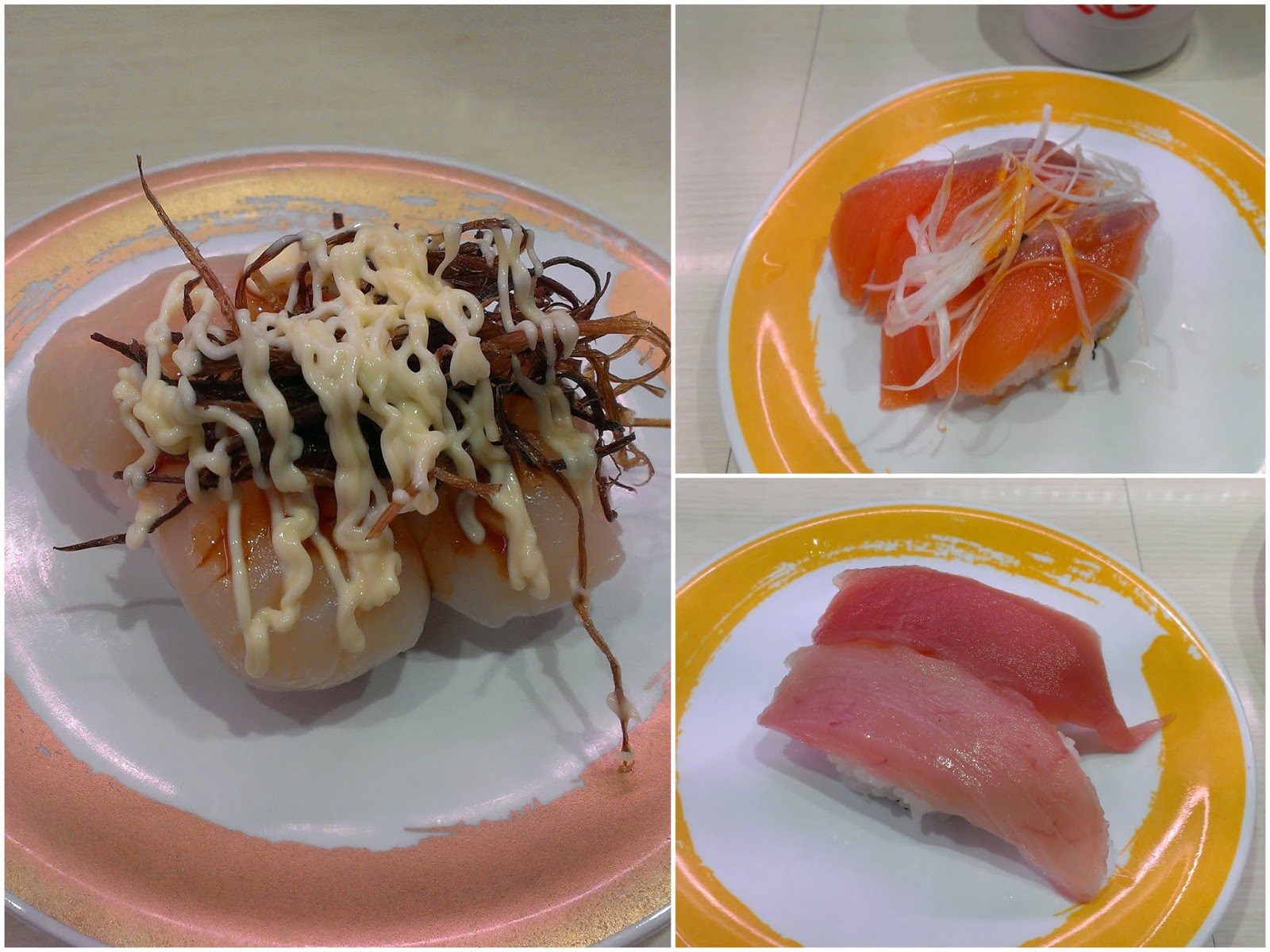
I also had my favourite dish from the first visit, sweet shrimp topped with burnt leeks and Kewpie, but this time with raw scallop and then, because it was so good, with boiled octopus too. The scallop version was possibly the single most delicious thing I put in my mouth on the whole trip; the combination of soft, sweet, bitter and crispy being unbeatable. The salmon with spicy red oil and shredded raw leeks was also rather good.

There’s also a dessert menu available, although I can only comment on the slices of fresh pineapple, which made a welcome relief after all the fat and salt and were mercifully cheap compared to most Japanese fruit we encountered. Luckily the Ewing was far more up to the job and managed during her two visits the sweet potato cheesecake, the chestnut sponge cake and the green tea pudding, pictured. On our visit to Ueobi a group of four young American backpackers put away 16 bowls of cake and ice cream between them, which I had a sneaking amount of admiration for.

Kyoto, lying inland, doesn't share the same nigiri history as Tokyo. What it does, however specialize in, is sabazushi. Saba (mackerel) was originally bought to Kyoto over the so-called Saba Kaido, the "Mackerel Highway" between Kyoto and the fishing port of Obama in Fukui. To preserve them, the fillets of mackerel are lightly salted, then vinegared, before being pressed with sushi rice in a wooden mould before traditionally being wrapped in kelp.

To try the zabazushi we went for an early dinner at Izuju, which is handily located opposite the Yasaka Shrine. Inside is pretty tiny - the sushi being made at the front, leading through to five tables in the middle and a small kitchen out the back - but the traditional decor (the restaurant is nearly 100 tears old), with its curved wooden walls and sliding doors, is well worth checking out.

As well as the saba zushi they also offer inari pockets; deep fried tofu skin (another Kyoto specialty) stuffed with sushi rice and simmered vegetables. We chose a set which included the mackerel and tofu alongside hako (literally box) sushi which, quelle surprise, is pressed in box shaped moulds, and maki (roll) sushi.

Shortly after our beautiful platter of sushi was delivered to our table the chef quickly raced after the waitress jabbing his finger at something on the menu and gesticulating at us. While I politely nodded while carrying on attempting to eat my food the Ewing was more astute, noticing the warning 'please remove kelp before eating' and saving me the ignominy of battling my way through the tough and stringy band of seaweed that was wrapped around the mackerel.

The fish was god (nb, on retrospect I don't think it quite reached those lauded heights), although they recommend it without soy and overall I found it a little lacking next to my favourite nigiri sushi. The maki was beautiful, stuffed with strange shaped mushrooms and rolled omelette, something which also turned up in the hako. Other options for the box sushi include prawns and pike eel, that look like beautiful mosaics.
My favourite, surprisingly, was the inari pockets which featured a sweet tofu layer stuffed with a lemony rice and some strange little seeds that looked a little like cumin, but had a far more subtle, nutty flavour.

As well as a beautiful dinner we also got this beautiful view of the Yasaka Shrine, under a harvest moon, as we left the restaurant. This was followed by a nightime DIY tour of the back streets of the Kyoto, ably guided by the Ewing, that included the Gion district and the Potochino. A fglorious and beguiling city that deserves to be on any traveller's must see list.

Being the world’s biggest fish eaters, some 80kg each per year, and with only twenty four hours in the day to fit it all in, you know fish is going to feature in some way at the breakfast table. Alongside miso soup, traditionally with a bonito based stock, and the ever present rice there is often a pick‘n’mix of rolled omelette, pickles, natto (fermented soya beans) and salted fish.
I had seen a poster in the window of Matsuya, a famous Japanese chain of restaurants, while we were walking around Kyoto, but somehow the feat of making it back there before 11 am seemed beyond us. Thankfully I found a branch near the post office in Shinjuku, a five minute walk from our hotel, and we made it there for 10.50 on our penultimate morning.

Like many casual places the vending machine is king and all meals are ordered and paid for before you are seated. Helpful pictures helped us locate the breakfast set meals and we both chose the salmon collar- beef gyudon and fried sausage and eggs are also available – for 450 Yen (£2.50).
After sitting down at the horseshoe shaped counter and handing tickets over top the waitress several more baffling choices of additional extras quickly followed, although the laminated picture cards helped a little, and five minutes later our meals were in front of us.

If you haven’t yet had your eyes opened to the delights of slated salmon in the morning, I can highly recommend it, what I would struggle to recommend however was the hulking great block of tofu, supplemented with yet more fish in the form of bonito flakes, that came as my chosen side dish. No one deserves to eat that much tofu, especially before midday.
My pale and wobbling block of coagulated soya was nothing compared to the Ewing’s choice of grated yam, which turned up looking a little like American style grits but with the texture of ectoplasm. The other options included natto, a fermented soya bean that’s equally slimy and also smells like an unwashed gym kit. An eastern Marmite, perhaps?
Trying to watch the Ewing battle with the yam and a pair of chopsticks (alongside her stringently tasting every one of the five mystery condiments on the bench) was probably the highlight of my meal. I would also like to thank her for not only eating all the yam but also 93% of my tofu.

We also had time for a late night fishy interlude at another popular chain restaurant, Yoshino. Yoshino are most well known for their beef gyudon, a sort of thinly sliced beef and onion mix that’s simmered in dashi stock and served on rice. Due to BSE found in US cattle at the beginning of the century Yoshina stopped their beef imports and so couldn’t find enough short plate (the cut needed) to make their gyudon bowls for the first time since the first restaurant opened in 1899.
Despite the introduction of pork bowls (butadon) instead, the public’s love didn’t waiver. As the years went by beef bowls were reintroduced for special occasion, such as 2006’s one day the ‘beef bowl revival festival’ and occasionally during limited serving times, but it wasn’t until 2008 that the guydon was permanently back on the menu around the clock (most restaurants are open 24 hours).

Back to the fish and the Ewing went for their unagi bowl, served with pickles and miso soup. At 700 yen (£4.20) for one eel fillet on rice and sides, this represented an extravagant blow out (multiple eel fillets are also available but we were running out of the cold hard cash, at least until we could find an international ATM, and so showed some restraint) but was worth every penny.

I had to try the mythical gyudon, served in a set with a side of corn salad and sesame dressing for a frankly laughable 350 Yen (2.20). Many around me were eating theirs with a raw egg stirred in, but I just went for lashing of beni shōga (pink pickled ginger) and a dash of soy. Despite its rather average appearance I suddenly understood the appeal of queuing up for this stuff during the dark days of the beef shortage, it truly was supreme and one of the few dishes from the trip I really long for since being back home. Forget another ramen restaurant, the Big smoke needs beef bowls!

A blog about fish (and, it seems, gyudon) wouldn't be complete without the jewel in Japan’s crown, Tsujiki fish market. This place is legendary, and for a reason. Every year it handles over 600,000 tonnes of seafood or 1 in every 5 fish caught. While you can find over 480 types of fish, tuna is king with the most expensive specimen selling for over a million US dollars.

Access to the tuna auctions has been restricted to tourists since a charmingly inebriated Brit licked the head of a frozen tuna and another tourist turned up naked in a wooden handcart used for making deliveries, but that doesn't stop hundreds of people queuing up from three o'clock every morning for a chance to pick up one of the 120 fluorescent tabards that allow you to see some action live for yourself.
Sadly we weren't one of the lucky few - to be fair we were still deep in a slumber as the hypnotic bell ringing and frantic nodding and shouting began, and didn't arrive until a far more civilised hour. If you want to see a slice of the fascinating action in full flow and cant get to the Chuo District anytime soon try YouTube, where you can also see the sheer size of some of the magnificent fish that are up for grabs.

Although we missed the main action the market was still a swarming mass of activity come mid-morning. While many of the fish had been bought and sold we still saw endless barrels of eels, buckets of fish heads and piles of crushed ice topped with everything from the finest fillets to brains and fins. Electric band saws hummed as they made light work of huge hunks of frozen tuna but, even at that time of the day, watch out for the fleet of motorised vehicles that whizz up and down through the impossibly narrow walkways at a demon speed. This is the most cutthroat I saw the placid Japanese throughout my visit; these guys won't stop for anyone.
Following on in the Japanese tradition, and despite all the blood and guts, everything remained relatively spotless. Oddly the market itself didn't smell at all fishy, with the strongest piscine whiff coming when we got off the metro and were walking through the underground station. With most the catch being sold we had the opportunity to see the grand cleaning down process - wear old clothes if your worried about being hosed down as you wonder through - which is far more fascinating than you may think, alongside some wonderful displays of knife sharpening.

After the buzz of the market we moved to the out warren of streets, which by this point on a Saturday afternoon were postively thronging with people.Top sushi joints around the market, and there are a few, include Daiwa Sushi and Sushidai which, with only one small counter in each, often have crouds of three otr four hours plus. While I don't mind a wait for my lunch, breakfast seemed like a long way away so we picked the slightly less daunting queue outside Sushi Zanmai's flagship branch. A quick wait and we were soon seated at their upstairs counter for lunch.

As time goes on I realise more and more that, despite all the endless varieties of fish and seafood in the sea, my heart really belongs to tuna. I'm far from a fussy eater, and enjoy most types of sushi, but there are always a few that come and crash the party. Crunchy fish roe leaves me cold, sea urchin makes me shudder, surf clams are often like chewing gum and raw oysters, what ever anyone says about 'growing to like them', are awful.

The Ewing indulged her love for the weird and wonderful by choosing their second set, a mixture of assorted fish and crustaceans. Alongside a huge strip of unagi and a ginat prawn, complete with eyes on stalks, there was tuna, squid wrapped in perilla, sea urchin, crab with a topping of crab brains, salmon roe, chines chives and tamago.

While my wife went with her crazy underwater pick'n'mix ere I was free indulge my love of maguro with the special tuna set; maki rolls, blow torched tuna, freshly minced tuna gunkan and a selection of akami, chutoro and otoro, of which my favourite was probably the middle. Not too fatty, not too lean, just right.
In fact it was all perfect; nothing squidgy, crunchy, slimy or bitter; nothing that popped unexpectedly as you bit in to it, and nothing that wriggled or writhed. It just like my own imagining of my favourite scene in Home Alone (that's fast becoming a theme on the blog) where Kevin orders the cheese and tomato pizza. The king of the sea, all for me, and my perfect plate of (mostly) raw fish.


